3:2 vs 6:5 Blackjack Payouts: Why This Ratio Changes Everything
A three-to-two payout on natural blackjack costs a player 1.39% of their bankroll over time. Six-to-five costs 1.92%. The difference, compounded across a year of play, is the difference between a night out and a second mortgage. It matters.
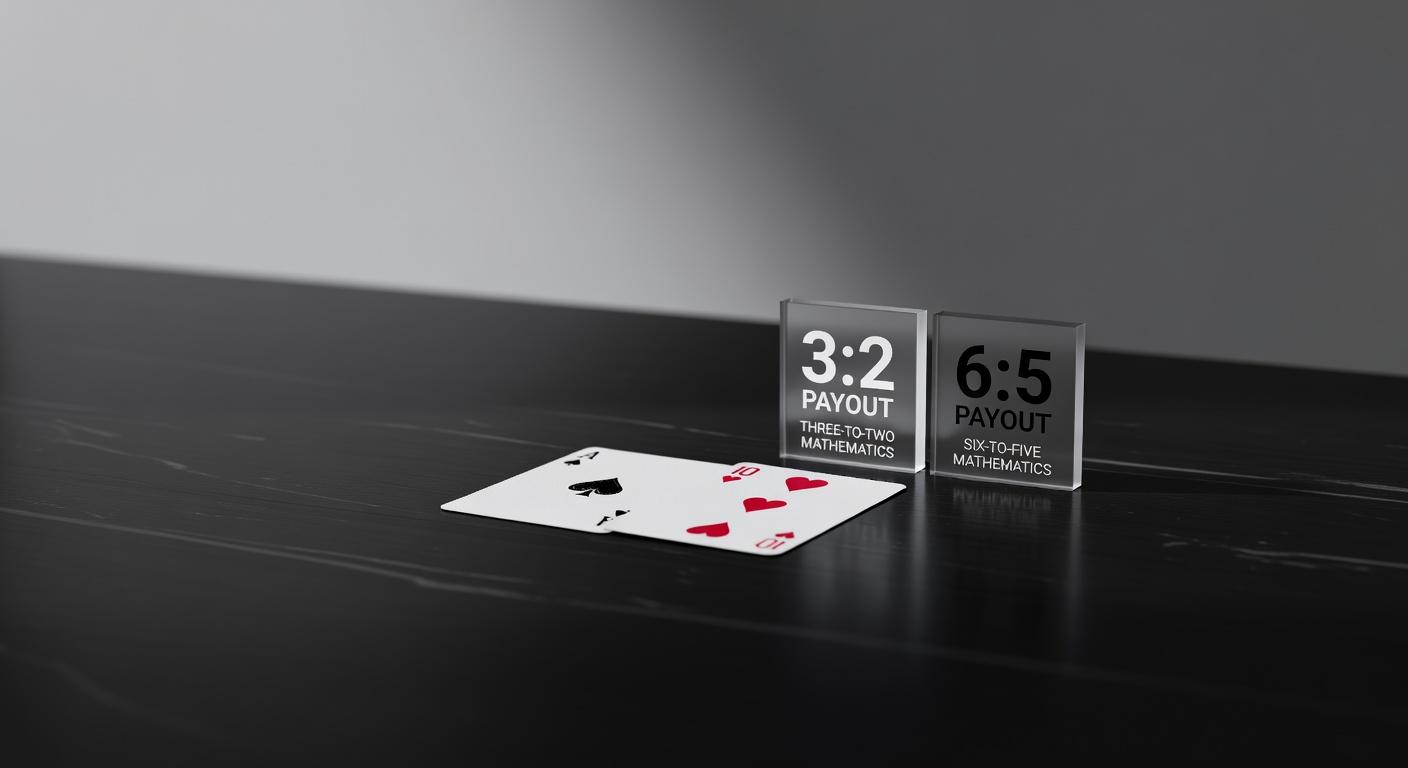
Walk into any Vegas casino built before 1990 and the blackjack arithmetic feels simple: a natural 21 pays 3 to 2. You bet 100, you win 150. You understand the equation immediately.
Since 2003, casinos started replacing that ratio with 6 to 5 on high-limit and tournament tables. You bet 100, you win 120. The transaction looks similar. The brain does not do the math.
The Actual Cost
When you hold a natural blackjack against a dealer's non-blackjack hand, a 3:2 payout gives you an edge of exactly 1.39% over the house, assuming you play perfect basic strategy. Six-to-five drops that to negative 1.92% house advantage. That is not a typo. The player advantage becomes a player disadvantage.
Consider a $100-per-hand average bet at a $5 minimum table. Over 100 hands (roughly two hours of play), you expect to hit blackjack about 4 or 5 times. At 3:2, those five naturals yield $750 in total payouts. At 6:5, you get $600. That is $150 gone in a single evening, and the game looks identical.
Expand that to 52 weeks of weekly visits. If you play twice a week at a 3:2 table, the house takes about 0.5%. At 6:5, you are giving the house 1.4%. Over the course of a year, the difference between those two rates, applied to a $10,000 annual gambling budget, is roughly $900.
Where You Still Find 3:2
Lower-limit tables, specifically $5 to $25 minimums, still commonly offer 3:2 payouts. The reason is economic: casinos accept slightly lower margin on smaller bets because the volume of players creates sufficient profit. High-limit rooms (above $50 minimum) frequently moved to 6:5 beginning in the 2010s, betting that whale players did not read the felt closely enough.
Most online casinos dealing blackjack, including those serving North American players who do not have access to MGA or Curaçao eGaming licensed sites, standardize on 3:2 because the payout is part of the software architecture. Changing it requires a system rebuild.
The Design Question
A casino architect thinks about the table as a tool for producing revenue. The 3:2-to-6:5 shift is not a change in rules; it is a change in the machine's efficiency. The same felt, the same shoe, the same dealer, the same hour of operation, now generating 0.5% more house profit per hand.
From a pure design perspective, it works. Player behavior does not change. The eye cannot detect the difference in a single hand. Most players who lose money at 6:5 believe they are at a 3:2 table. The upgrade is invisible until you tabulate six months of losses.
That invisibility is the entire point. If casinos reduced payouts by 50% explicitly, volume would collapse. But shrink the ratio by 3.33% and embed it in the lowest-reading moment of the hand (the payout), and the market absorbs it.
What to Do
If you play blackjack, ask before sitting down. The payout is printed on the felt. Read it. If you see "6:5 BJ" anywhere, that table is a wealth transfer from you to the house. Play elsewhere, or do not play at all. The difference is real, and it compounds.
Next notes
More from #jackpots

Crypto Jackpot Slots: Who Funds the Prize, and in What Coin
A jackpot slot pays its top prize out of every spin you make. How the meter is funded, what it does to RTP, and what that means for a wallet balance.

Mattress Mack's 75 Million Dollar Astros World Series Win
Jim McIngvale's 75 million dollar World Series bet in 2022 represents a rare intersection of narrative and reinforcement learning. What it reveals about gambling behavior.

Craps Records: The Longest Rolls Ever Documented
On May 23, 1989, a woman named Patricia Demauro walked to a craps table. She rolled the dice for four hours. What happened in those four hours changed craps forever.

Daily Jackpots vs Mega Jackpots: Key Differences
The difference between daily and mega jackpots is not subtle when you examine the mechanical distributions. One is designed for consistent hits. One is designed for the rare life-changing moment.

Joseph Jagger: The Engineer Who Solved Monte Carlo's Roulette Wheel
In 1873, an English mill engineer hired clerks to record every roulette spin at Monte Carlo. He found a wheel bias and walked away with 65000 francs.

The Crown Casino Scam: How 33 Million Was Stolen via CCTV
In 2013, a Crown Melbourne employee and his network stole 33 million in chips using security footage and inside help. It was not complicated. It was methodical.