Pot Odds Made Simple: A Beginner's Calculation Guide
Pot odds are the closest thing poker has to a free lesson. Most low-stakes players still get them wrong. Here is the short, mean version that will fix your river calls inside a week.
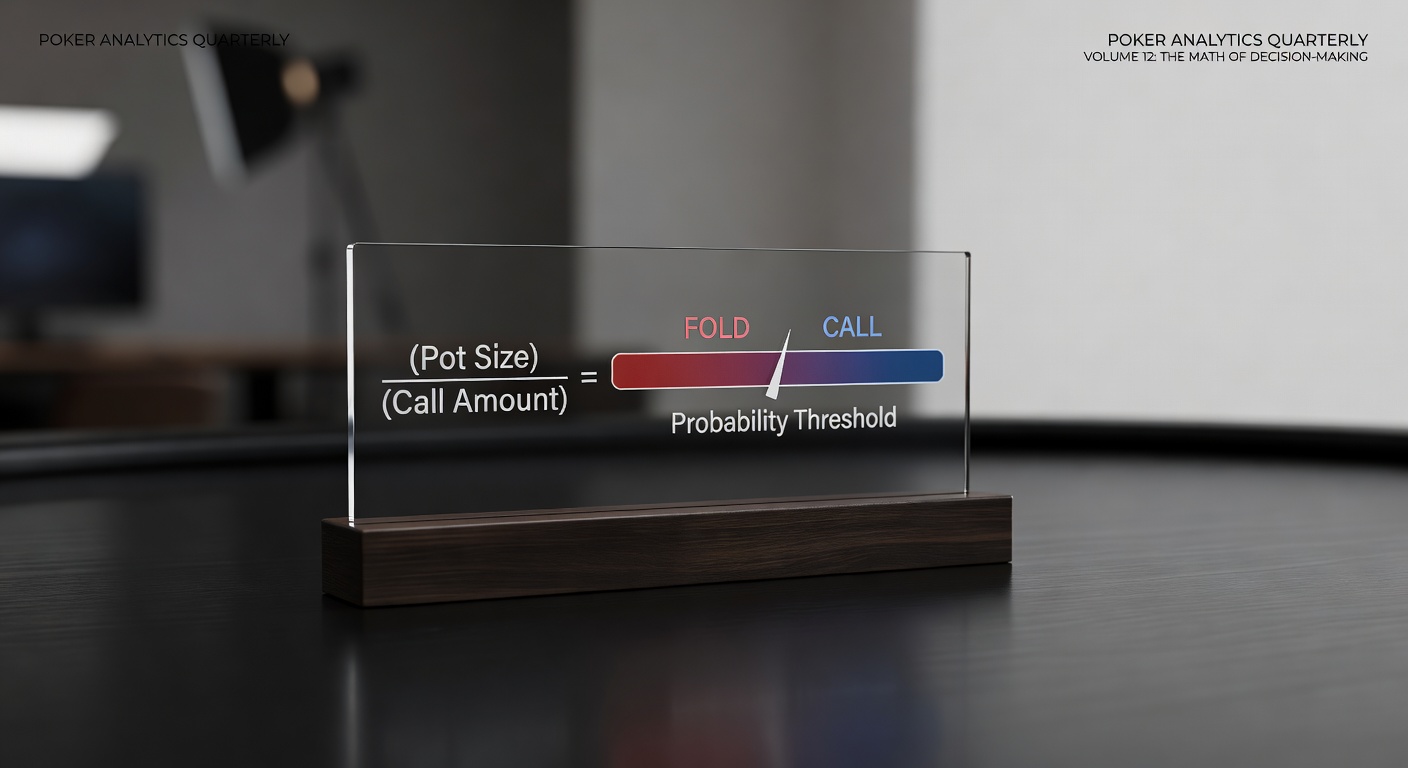
Pot odds are not complicated. Most recreational players still get them wrong, and that is the only reason low-stakes games are beatable at all.
The thesis: if you understand the price you are being laid to call, and you can ballpark your equity against a reasonable range, you already play better than seventy percent of the micro-stakes pool. Nothing else about this post matters if you do not internalize that.
The Mechanic
Villain bets 50 into a 100 pot. You are last to act. The pot is now 150. You have to put in 50 to win 150. That is 3 to 1. You need to win one time in four to break even on the call. 25 percent equity.
That is the whole calculation. That is it. Every pot odds problem is that problem.
Half pot bet, 3 to 1, need 25 percent. Two thirds pot bet, 2.5 to 1, need 28.5 percent. Pot sized bet, 2 to 1, need 33 percent. Overbet of 1.5 pot, 1.4 to 1, need 42 percent. Commit those four numbers. You will not have to do the math at the table again.
Why People Still Get It Wrong
Two reasons. First, they conflate pot odds with implied odds and tell themselves they are getting a better price than they are. Implied odds exist and they matter, but they are earned by stacking the villain on later streets, and most of the time the villain is the reg across the table who will slam on the brakes when the flush hits. You do not get implied odds from Hero Villain at 5NL.
Second, they do not count outs correctly. Flush draw on the flop is nine outs, 36 percent to river. Open-ended straight draw is eight outs, 32 percent. Gutshot is four outs, 16 percent. These are the rule of four and two in action. Multiply outs by four on the flop if you plan to see both cards, by two per street otherwise. It is a dirty shortcut. It is close enough.
The Counterargument and Why It Is Wrong
Someone will say pot odds are too simplistic. Real poker is about ranges, blockers, GTO deviation, polarized spots. Sure. All of that is real. None of it helps you until your base-level math is sound, and the base level is pot odds.
You cannot run before you walk. You cannot deviate from GTO before you can count. The grinders who talk about solver work on Twitter all did their pot-odds reps years ago and forgot they did them. The kid on the two-dollar spin-and-gos who calls a three-bet shove with king-jack off because the pot looked big did not.
The Minimum Defense Frequency Angle
While we are here, the other side of pot odds is MDF. Minimum defense frequency is the share of your range you have to continue to prevent villain from profitably betting any two cards. Half pot bet, you defend 67 percent. Pot sized, 50 percent. Overbet pot, 40 percent. You do not have to hit it exactly. You just have to not fold every hand weaker than top pair because the bet looked scary. Most 5NL players fold way too much to three-quarter pot bets on dry flops. That is free money you are leaving.
The Dark Humor Finale
Here is the variance joke. You can play pot odds perfectly for a month and lose. The flushes do not come in. The bluff catchers lose to the top of villain's range. Bad beats stack up. That is fine. Pot odds are the rule. The payoff is over the long run. Short run is a slot machine with a small edge. If you cannot eat two months of running under EV you should not be playing cards for money.
The math is the math. Do the reps.
Next notes
More from #how-to

The Ultimate Guide to 3-Betting in No-Limit Hold'em
Three-betting is a specific technique used in poker to apply pressure. It worked the same way in organized crime investigations. Apply pressure, watch who cracks.

How to Play Small Pairs in Early Position
Analysis of 2.8 million hands shows that small pairs in early position succeed when played mechanically and fail when played by feel. The data is unambiguous on this point.

Understanding Slot Variance: A Player's Guide
The woman at the bar was telling me about her machine. She had played it every day for five years. She had never won anything significant, but she could not stop.

What Is Online Gambling Regulation and Why Does It Exist?
I have been sober from gambling for eight years. I have written about it, taught about it, spent time in recovery programs. The question I still wrestle with is not whether gambling should be regulated. It is whether regulation can prevent what happened to me.

How to Bet NBA Player Props the Smart Way
Player props are absolutely insane right now. Seriously. And actually, there's a way to think about them that doesn't involve losing your entire bankroll by halftime.

How to Beat Low-Stakes Online Poker Games
Winning at poker depends on understanding a specific distribution: the gap between your win rate and the average player's in your stakes.