How to Track Your Poker Results Like a Pro
A Tuesday grind, a laptop, and a cheap notebook. The difference between a pro and a break-even reg is not talent. It is the stack of data the pro has on himself. Here is how the grinders actually keep score.
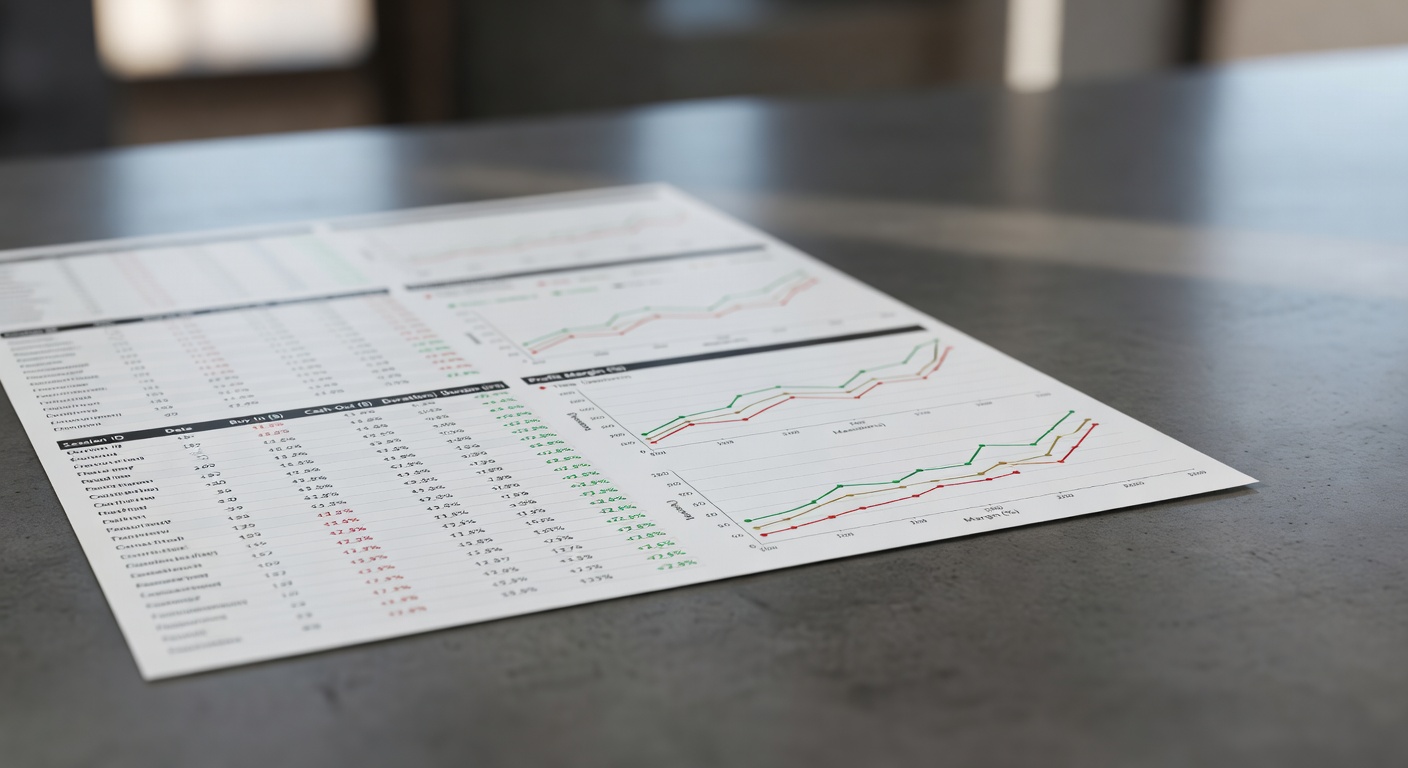
Rio All-Suite Hotel. Amazon Room. A kid named Dylan, 23, Toronto, two live cashes. He is the one you are watching, not because he just shoved on the button but because between hands he is writing in a Moleskine. Little numbers. Tiny shorthand. He closes the book. He plays the next hand.
That notebook is the whole story.
You cannot improve what you do not measure. The grinders who last the decade are the ones who kept receipts.
The rest of them disappear.
What Dylan Writes Down
By the time he dumps his notebook into a spreadsheet later that night, he has the essentials. Date. Venue. Game. Stakes. Buy-in. Cash-out. Hours logged. He notes whether he played tired, angry, drunk, or sharp. He flags one hand per session. Not the biggest pot. The one where he knows he played bad. That is the hand he reviews the next morning.
The pros I have covered for fifteen years all do some version of this. Phil Galfond, the Run It Once founder, has said publicly that he tracked every session of his early career in hand-written logs. Doug Polk has talked on stream about his spreadsheet habits through his Upswing days. None of them did this because they loved data entry. They did it because the alternative is the thing the recreational player does, which is remember the wins and forget the losses.
The Online Grinder's Kit
For online cash players, the stack is different and the tooling is heavier. The standard kit includes:
- A tracking client: Hold'em Manager 3 or PokerTracker 4. Both import hand histories automatically from the major sites. Both compute win rates in big blinds per 100 hands, which is the only meaningful unit.
- A HUD, overlaid on the tables, running those same stats in real time.
- A separate journal. Text file, Notion, paper, whatever. The journal is not data. It is self-observation. What did I notice about myself today. Where did I tilt.
- A schedule tracker, because volume lies. Ninety thousand hands in a month at 200NL sounds like a lot until you realize a pro runs triple that.
The tracking client gives you your win rate. The journal gives you why. Confusing the two is the first mistake recreational players make.
Live Tracking Is Harder and More Important
Live poker does not hand you a clean hand history. You have to build it yourself. The format most touring pros use is simple: session-level data only, no hand-level data. You log the game, the location, the stakes, the hours, the net, and your mental state. You do not try to reconstruct hands after the fact. Memory is garbage at that granularity.
The reason live tracking matters more, not less, than online: live games have higher variance per hour, fewer hands for statistical significance, and far more travel cost. A live pro needs three years of data to know if he is a winner. An online pro knows in six months.
The Review Discipline
I talked to Kristen Foxen at the WSOP about this two years ago. She said the hardest part was not logging. It was looking at the logs on days when the logs were ugly. Most people who start a tracker quit after a losing week. They stop updating it. They tell themselves they will start again when they are running better. They never do.
The grinders review weekly. Monthly at minimum. They look for patterns. Late-night sessions bleeding out. A specific stake that is underwater across a year. A particular tournament series that turns into a time-and-money vacuum.
What the Notebook Is Actually For
Back in the Amazon Room, Dylan busts on Day 2. Top pair, middle kicker, ran into a set. He writes the hand down before he leaves the table. He tips the dealer. He walks out.
The notebook is not for the poker. The notebook is for the gap between who he was at the start of the session and who he needs to be by the end of the year. That gap closes one logged hour at a time, or it does not close at all.
Next notes
More from #jackpots

Crypto Jackpot Slots: Who Funds the Prize, and in What Coin
A jackpot slot pays its top prize out of every spin you make. How the meter is funded, what it does to RTP, and what that means for a wallet balance.

Mattress Mack's 75 Million Dollar Astros World Series Win
Jim McIngvale's 75 million dollar World Series bet in 2022 represents a rare intersection of narrative and reinforcement learning. What it reveals about gambling behavior.
Craps Records: The Longest Rolls Ever Documented
On May 23, 1989, a woman named Patricia Demauro walked to a craps table. She rolled the dice for four hours. What happened in those four hours changed craps forever.

Daily Jackpots vs Mega Jackpots: Key Differences
The difference between daily and mega jackpots is not subtle when you examine the mechanical distributions. One is designed for consistent hits. One is designed for the rare life-changing moment.
Joseph Jagger: The Engineer Who Solved Monte Carlo's Roulette Wheel
In 1873, an English mill engineer hired clerks to record every roulette spin at Monte Carlo. He found a wheel bias and walked away with 65000 francs.
The Crown Casino Scam: How 33 Million Was Stolen via CCTV
In 2013, a Crown Melbourne employee and his network stole 33 million in chips using security footage and inside help. It was not complicated. It was methodical.