How to Handicap Tennis Matches on Different Court Surfaces
I spent six years in online sportsbooks. One year in, I was winning. Three years in, I was losing. The thing nobody tells you is how much of it depends on details like court surface. I learned the hard way.
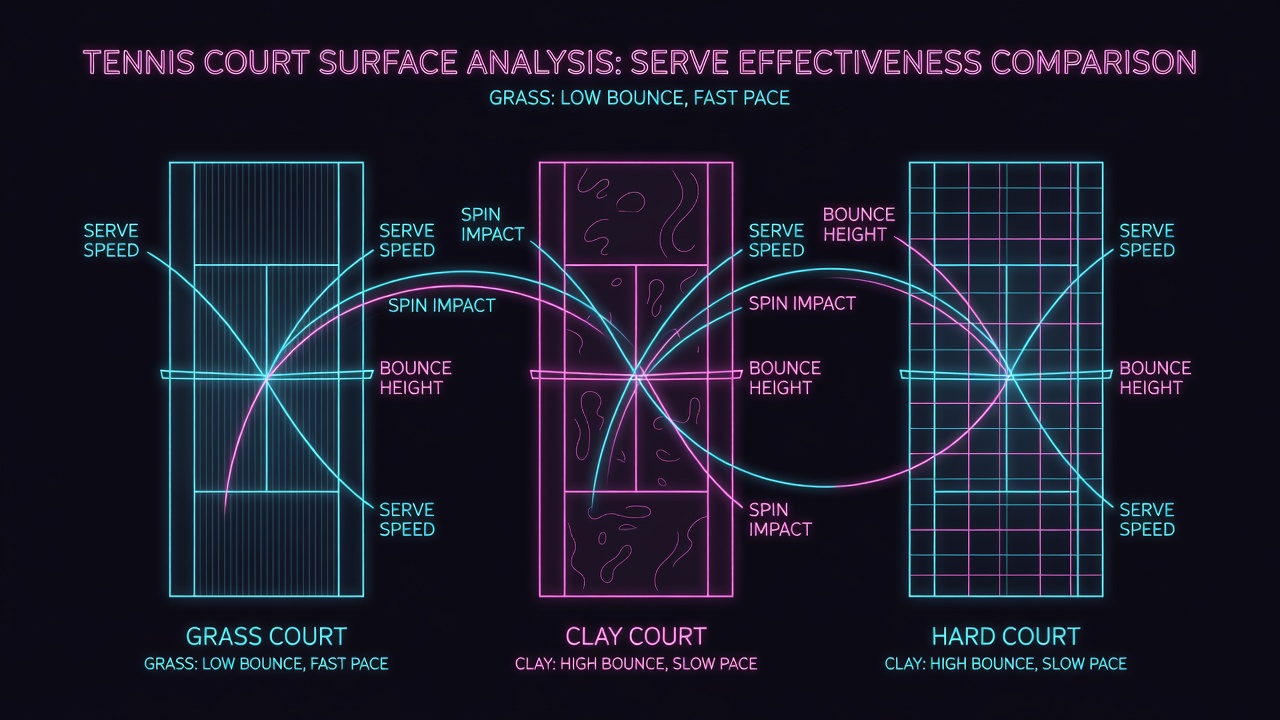
Tennis is a sport where surface matters more than almost any other variable. I didn't understand this when I started betting. I learned it the way most people learn painful lessons: by losing money.
There are four main surfaces: hard court (Australian Open, US Open), clay (French Open), grass (Wimbledon), and indoor hard court. Each one changes the game in specific ways. Once you understand how, you can see where betting markets underprice or overprice players.
Hard Court
Hard court is the fastest surface. The ball bounces high and quickly. Points are short. Players who serve well dominate. If you're playing hard court, a big server like Pete Sampras or nowadays Goran Ivanisevic wins at a higher rate than they would on clay.
I bet on a match between a baseline player and a server six years ago. Didn't account for surface. Lost money I couldn't afford to lose. The baseline player was ranked higher, had the better record head-to-head. But the match was on hard court. The server won 6-2, 6-1. I'd been looking at aggregate statistics without factoring local conditions.
When handicapping hard court, look at first-serve percentages and break-point conversion rates. A player who serves 65% first serves is more valuable on hard court than one who serves 55%. The margin matters.
Clay
Clay is the slowest surface. Points are long. Movement matters more than raw power. Players with better footwork and consistency win at higher rates.
Rafael Nadal won 14 French Opens partly because clay favors certain skill sets. On hard court, his advantage narrows. This is real, measurable, and not fully priced into markets.
When handicapping clay, look at rally length stats. How many shots per point does a player hit? On clay, players with high rally counts relative to their ranking do better than expected. The slow surface exposes inconsistency. A player who feels good hitting 15-shot rallies looks better than a player who panics when forced into extended points.
Grass
Grass is the second-fastest surface. Points are short, but not as short as hard court. Grass favors serve-and-volley players, but modern Wimbledon is dominated by baseline players with heavy hitting power.
I watched a player I'd been betting on for months lose at Wimbledon to someone ranked 40 spots lower. The lower-ranked player was a serve-and-volley specialist. On grass, his old-school game worked. In the betting markets, he was still priced as if they were playing on hard court. Simple efficiency play: find undervalued players who specialize in serve-and-volley or net play, at Wimbledon. The grass brings out their edge.
Indoor Hard Court
Indoor hard court is the fastest hard court. Slightly different bounce than outdoor. Some players adapt quickly. Others don't. This is a micro-variable that separates sharp bettors from casual ones.
Practical Handicapping
Here's what I learned by losing money and eventually making some back:
First, look at a player's record on each surface. Djokovic on hard court is better than Djokovic on clay. Not by a huge margin, but measurably. If the market is pricing him as if surface doesn't matter, he's a value bet on hard court and a fade on clay.
Second, check the schedule. A player who just finished a tournament on one surface, then immediately travels for a tournament on a different surface, often struggles. They haven't adjusted. They're practicing strokes for the old surface. This takes a few matches to recalibrate.
Third, ignore ranking temporarily. A ranked #150 grass specialist might beat a ranked #50 all-surface player at Wimbledon. Markets try to account for this, but they lag behind specialists who watch the game closely.
Fourth, look at head-to-head matchups on specific surfaces. Djokovic versus Nadal has one record. Djokovic versus Nadal on clay has a different record. The second one is more informative for betting on a clay court match.
The lesson I learned, which took two years and steady losses to accept, is that sports betting's edge comes from noticing what others miss. Surface specialization is obvious once you see it. Most casual bettors don't see it. For a while, before the market caught up, it was where I made money.
Now I mostly don't bet. When I do, I only bet on specific instances where I see a real discrepancy. The days of trying to make a living off this are gone, and I'm better for it.
Next notes
More from #how-to

The Ultimate Guide to 3-Betting in No-Limit Hold'em
Three-betting is a specific technique used in poker to apply pressure. It worked the same way in organized crime investigations. Apply pressure, watch who cracks.

How to Play Small Pairs in Early Position
Analysis of 2.8 million hands shows that small pairs in early position succeed when played mechanically and fail when played by feel. The data is unambiguous on this point.

Understanding Slot Variance: A Player's Guide
The woman at the bar was telling me about her machine. She had played it every day for five years. She had never won anything significant, but she could not stop.

What Is Online Gambling Regulation and Why Does It Exist?
I have been sober from gambling for eight years. I have written about it, taught about it, spent time in recovery programs. The question I still wrestle with is not whether gambling should be regulated. It is whether regulation can prevent what happened to me.

How to Bet NBA Player Props the Smart Way
Player props are absolutely insane right now. Seriously. And actually, there's a way to think about them that doesn't involve losing your entire bankroll by halftime.

How to Beat Low-Stakes Online Poker Games
Winning at poker depends on understanding a specific distribution: the gap between your win rate and the average player's in your stakes.