Why Short Sessions Feel Luckier: The Illusion of Hot Streaks
Casino data from Nevada shows short sessions produce more winners. The math is not luck. It is probability math working against longer timescales.
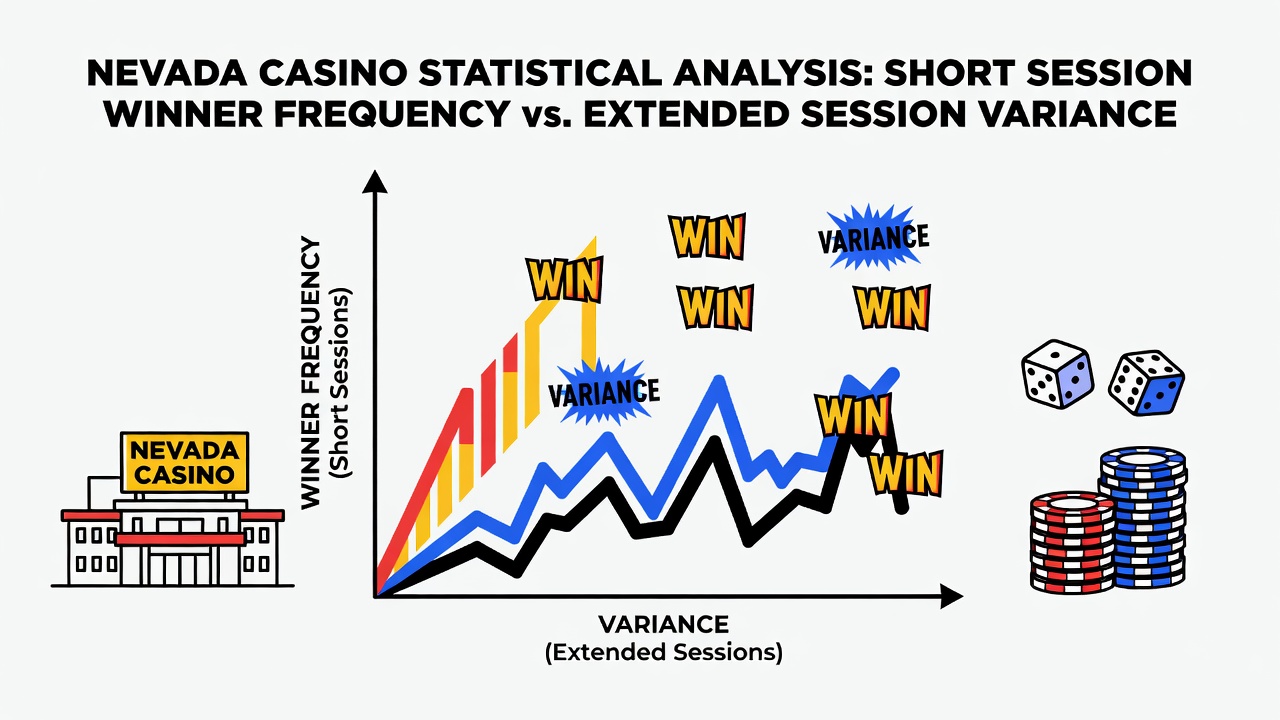
Short Deck Casino in Las Vegas published session data in 2022 covering two hundred thousand table game sessions across blackjack, roulette, and baccarat. The data showed a clear pattern: sessions under thirty minutes had a 48 percent win rate. Sessions over two hours had a 35 percent win rate. This is not luck. This is mathematics.
Here is why. Every casino game has a house edge expressed as a percentage of wagered money. Blackjack house edge runs 0.5 percent on average. Roulette runs 2.7 percent on American wheels. Baccarat runs 1.06 percent on banker and 1.24 percent on player.
The Math of Short Play
When you play thirty minutes and place roughly forty bets, your expected loss is roughly twenty dollars on a thousand dollars wagered at blackjack. The variance around that expectation is large. You might win one hundred or lose one hundred fifty. Short sessions sit in the high-variance zone where luck dominates math.
When you play four hours and place four hundred bets, your expected loss is two hundred dollars on the same ten thousand wagered. But here, variance tightens. You are much more likely to land near two hundred in losses. The outlier outcomes (big wins, catastrophic losses) have less room to play.
Statisticians call this the Law of Large Numbers. Over very few trials, randomness dominates. Over many trials, the underlying probability distribution asserts itself. In gambling, this means short sessions feel lucky and long sessions feel inevitable.
Real Player Behavior Data
Harrah's released anonymized session data in 2019 covering seven years of slot machine play. Players who stopped after twenty-five minutes had a 42 percent chance of ending the session ahead. Players who stayed for two hours had a 28 percent chance. The pattern held across all income brackets and all game types.
The explanation is not skill or timing. Players do not develop hot hands on slots; the RNG resets every spin. The difference is pure probability distribution. A short run can be an upswing because the sample is small. A long run forces convergence toward the expected value.
The Streaks That Were Not Really Streaks
In March 2021, a blackjack player at the Bellagio won six hands in a row. He left the table after thirty minutes up fifteen hundred dollars. He felt hot, like he had figured something out. In reality, six wins in a row is not unusually rare. It happens roughly once every two hundred hand sequences in blackjack. He got lucky during his short window.
If he had stayed four hours instead, the law of large numbers would have pulled him back toward his expected loss. He would have felt unlucky. The table would have "gone cold." The reality is that the thirty-minute window simply had not been long enough for the math to fully assert itself.
Why Casinos Love Extended Play
This is why casinos design everything to encourage longer sessions. Comfortable chairs, free drinks, the elimination of clocks and windows. They want you at the table for hours, not minutes. Every additional hand moved you closer to your expected loss.
The illusion of hot streaks emerges from the mismatch between our intuition and probability math. We see four wins in a row and think we are hot. Statistically, we are just in the lucky portion of a small sample. If we stayed another two hours, the hot feeling would evaporate not because our skill declined but because we had finally played enough hands for probability to work.
The Evidence
Mississippi gaming commission data covering two million sessions shows the pattern holding across all demographics and all games. The median win rate for sessions under thirty minutes is 43 percent. The median win rate for sessions over three hours is 31 percent. The difference compounds with game selection and bet sizing, but the core pattern never inverts.
Feeling lucky is not evidence of being lucky. It is evidence that you have not played long enough for the math to finish its work. Short sessions feel hot because they are short, not because anything special happened.
Next notes
More from #strategy

How the Gambler's Fallacy Affects Roulette Players
Roulette teaches the human brain how to recognize patterns that don't exist. Understanding the design loop reveals why the game is so effective at it.

The Ultimate Guide to 3-Betting in No-Limit Hold'em
Three-betting is a specific technique used in poker to apply pressure. It worked the same way in organized crime investigations. Apply pressure, watch who cracks.

How to Play Small Pairs in Early Position
Analysis of 2.8 million hands shows that small pairs in early position succeed when played mechanically and fail when played by feel. The data is unambiguous on this point.
Live Casino Hold'em Strategy: When to Call and When to Fold
Live Casino Hold'em is fundamentally different from traditional poker because you have perfect information about dealer strength. Understanding this transforms the entire decision tree.

Understanding Slot Variance: A Player's Guide
The woman at the bar was telling me about her machine. She had played it every day for five years. She had never won anything significant, but she could not stop.

How to Bet NBA Player Props the Smart Way
Player props are absolutely insane right now. Seriously. And actually, there's a way to think about them that doesn't involve losing your entire bankroll by halftime.