Double Ball Roulette Explained: Payouts, Odds, and Strategy
Double Ball Roulette emerged in 2010 as a variant designed to increase action and complexity. The mechanic shifts probabilities in ways that appear simple but operate differently than traditional roulette.
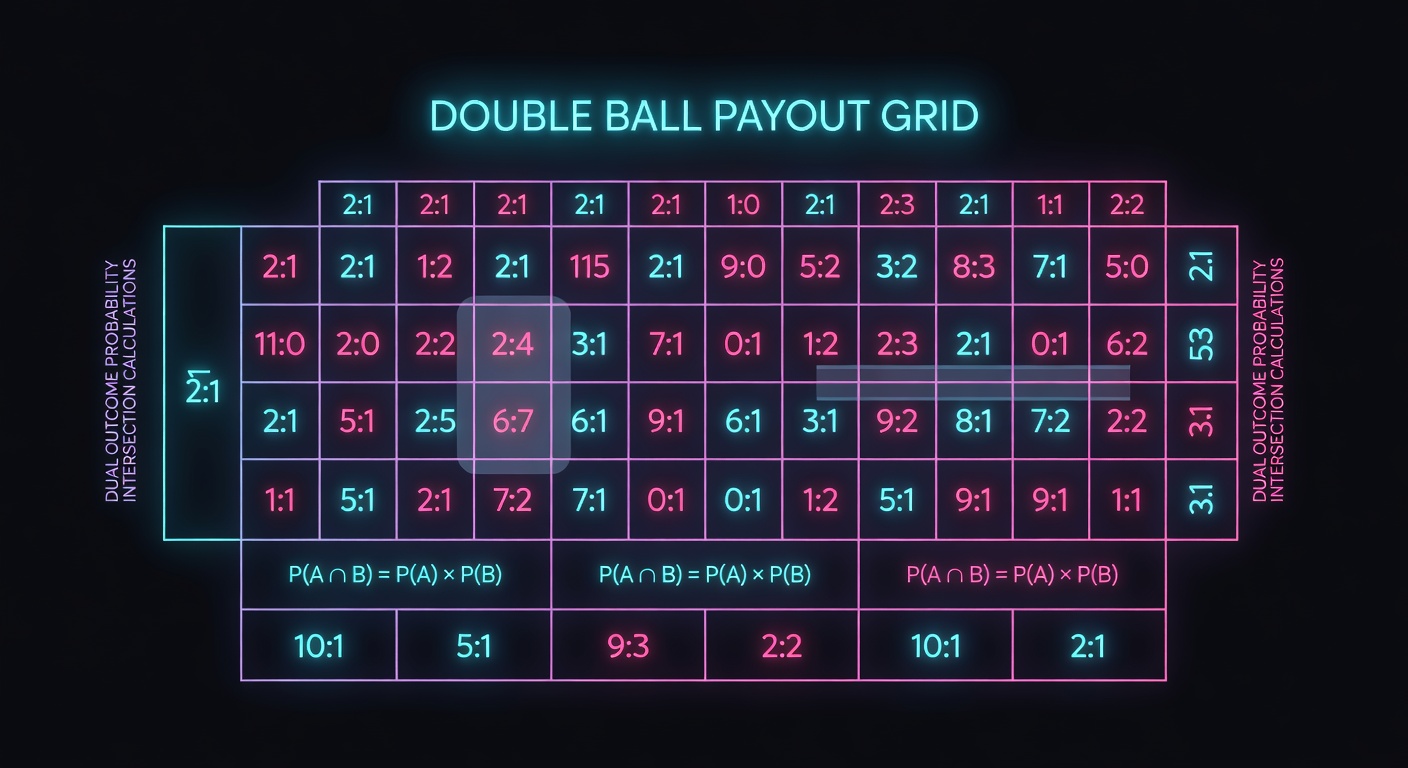
Double Ball Roulette premiered at the European Gaming Expo in 2010, introduced by Playtech. The innovation was straightforward: release two balls instead of one onto the roulette wheel. The design intent was to accelerate pace and generate dual-outcome betting.
The Mechanical Innovation
A standard roulette wheel in Double Ball Roulette is identical: 37 numbers (0-36 in European, 0-00-36 in American variants). The difference is the wheel rotates faster and is designed to accept two balls simultaneously without collision.
Two separate balls land. Two separate numbers win. The payouts are constructed around the likelihood that both balls land on the same number, different numbers, or specific combinations.
The Probability Shift
Traditional roulette: single ball, 37 possible outcomes, 35-to-1 payout on a single number.
Double Ball: two balls, 1,369 possible outcomes (37 times 37). A specific combination like Ball 1 on 17 and Ball 2 on 23 has 1,369-to-1 odds. But Playtech does not offer that bet.
Instead, payouts are tiered around probability density. Betting that both balls land on the same number: 37-to-1 (since there are 37 matching combinations out of 1,369). That's more likely than a specific number on traditional roulette but still a losing bet long-term due to the house rake.
European roulette: 2.70% edge on single numbers. Double Ball roulette: payouts are structured to maintain approximately 2.70% edge overall, distributed across different bet types.
Available Bets
Double Ball roulette offers several distinct bet types:
- Ball 1 specific number: 35-to-1 (traditional roulette equivalent)
- Ball 2 specific number: 35-to-1
- Both balls same number: 37-to-1 (roughly 2.7% of outcomes)
- Both balls in same dozen: 11-to-1 (significantly higher odds than single-ball)
- Both balls in same column: 11-to-1
The mathematical implication: bets involving both balls have lower odds-to-payout ratios because those outcomes are more likely. Single-ball bets have traditional roulette odds.
The Strategic Consideration
Double Ball introduces a theoretical edge if a player can identify wheel bias. However, the edge is narrower than traditional roulette because action is distributed across more outcomes.
Academic literature (Thomas et al., 2012) analyzed Double Ball outcomes from Playtech's London studio across 50,000+ spins. The distribution matched expected frequency to within 0.1%. No bias emerged.
From a variance perspective, Double Ball has higher volatility. A player betting Both Balls Same Number experiences longer downswings because the 37-to-1 bet hits roughly 2.7% of the time. Compare this to a traditional single-number bet (37-to-1 but with 50% frequency of single-ball outcome): variance profiles differ significantly.
Why Playtech Designed It
Double Ball was introduced to differentiate Playtech's live offering from competitors. Evolution Gaming and NetEnt had comparable roulette products. Double Ball created a unique product line.
From an operational perspective, it serves a secondary function: players bored with traditional roulette (which resolves in 60-90 seconds) find novelty in double outcomes. This can extend session duration without changing fundamental payouts.
The Practical Implication
Double Ball is not higher-variance in the player's favor. The house edge remains roughly 2.70% overall, though distributed differently across bet types.
A player seeking to "beat" roulette faces the same mathematical reality: negative expectation. Double Ball merely reorganizes the betting landscape without changing the underlying variance-to-payout ratio.
The historical significance is modest. Double Ball failed to achieve dominance in live casinos. By 2015, it represented less than 2% of live roulette action. Players preferred the simplicity and familiarity of traditional roulette.
Its legacy is as an example of how variance redistribution, not edge reduction, defines game variants.
Next notes
More from #how-to

The Ultimate Guide to 3-Betting in No-Limit Hold'em
Three-betting is a specific technique used in poker to apply pressure. It worked the same way in organized crime investigations. Apply pressure, watch who cracks.

How to Play Small Pairs in Early Position
Analysis of 2.8 million hands shows that small pairs in early position succeed when played mechanically and fail when played by feel. The data is unambiguous on this point.

Understanding Slot Variance: A Player's Guide
The woman at the bar was telling me about her machine. She had played it every day for five years. She had never won anything significant, but she could not stop.

What Is Online Gambling Regulation and Why Does It Exist?
I have been sober from gambling for eight years. I have written about it, taught about it, spent time in recovery programs. The question I still wrestle with is not whether gambling should be regulated. It is whether regulation can prevent what happened to me.

How to Bet NBA Player Props the Smart Way
Player props are absolutely insane right now. Seriously. And actually, there's a way to think about them that doesn't involve losing your entire bankroll by halftime.

How to Beat Low-Stakes Online Poker Games
Winning at poker depends on understanding a specific distribution: the gap between your win rate and the average player's in your stakes.