Pending Time vs Processing Time in Casino Payouts
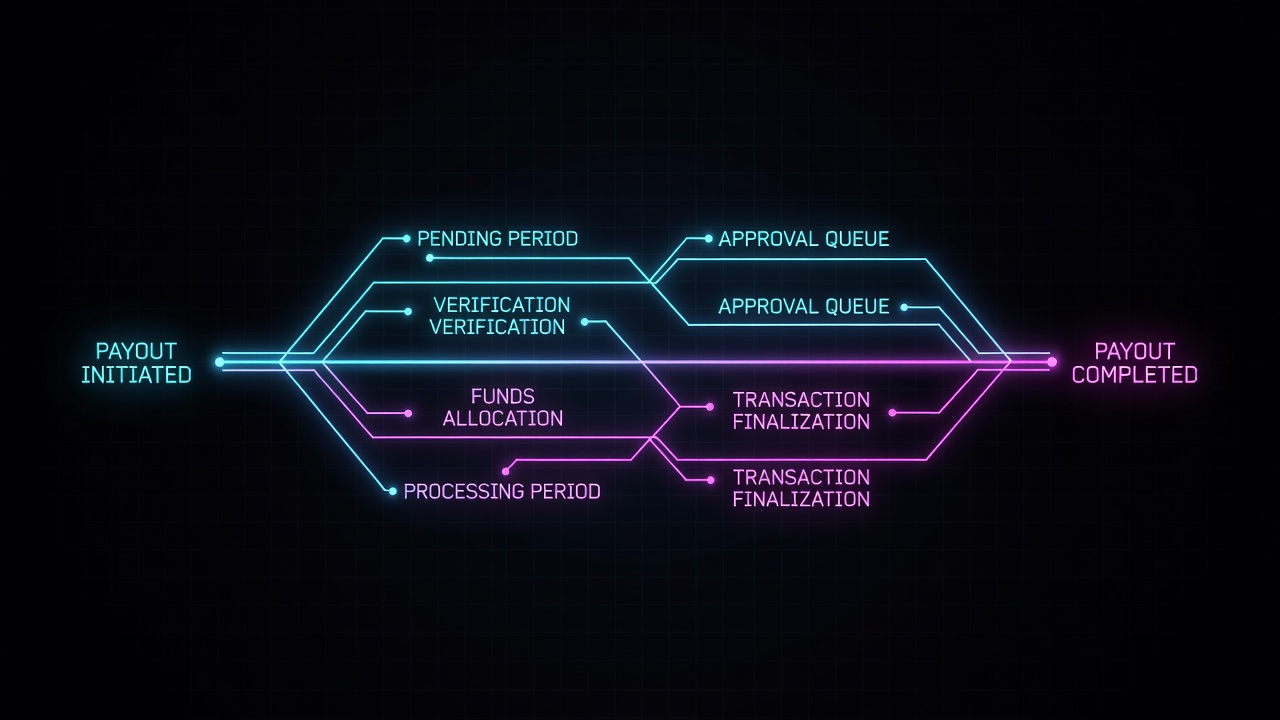
A payout has two timelines. Pending time is how long the casino takes to verify and approve your withdrawal. Processing time is how long the payment processor takes to send the money. A casino advertises processing time and hopes you forget about pending time.
In 1988, a young mathematician named Claude Shannon (actually a different man, not Shannon the information theorist) conducted an informal experiment at the Flamingo in Las Vegas. He won 15,000 dollars in a single evening and requested a cashout. The cage manager told him it would take "one to two hours." Shannon waited. Seven hours later, he received his money.
The cashier had not been lying. The time estimate was accurate. But the delay had been intentional. The casino was hoping Shannon would lose his patience, go back to the tables, and gamble away his winnings. Many players did exactly this.
Fast-forward to 2024. The mechanics have changed, but the principle remains. Casinos control the withdrawal timeline to influence player behavior.
Pending Time
Pending time is the time from when you request a withdrawal until the casino approves it. This is how long the casino takes to verify that the money is yours, that you meet the wagering requirements, that you have not violated any terms.
Most casinos say pending time is 24 to 48 hours. Some say 72 hours. A few say up to 7 days.
The variance depends on:
-
Automation. If the casino has automated most withdrawal checks, pending time is short (24 hours). If a human reviews every withdrawal, pending time is long (up to 7 days).
-
Size of withdrawal. Small withdrawals (under 1,000 dollars) might be instant. Large withdrawals (over 10,000 dollars) might require additional verification (source of funds, AML checks, proof of identity).
-
Regulatory jurisdiction. MGA-regulated casinos (Malta) tend to have faster pending times (24 hours) because the regulatory framework is predictable. Casinos in less-regulated jurisdictions might be slower.
Processing Time
Processing time is the time from when the casino approves the withdrawal until the money reaches your account. This is the payment processor's timeline.
Payment processors have their own timelines:
- Credit card reversal: 1 to 5 business days (the casino refunds money to the card)
- Bank transfer: 1 to 3 business days
- E-wallet (Skrill, Neteller): 1 day (sometimes instant)
- Crypto: 10 minutes to 1 hour for confirmation, then instant
Processing time is largely outside the casino's control. But casinos sometimes manipulate it by choosing slow processors.
The Combined Timeline
You request a withdrawal on Monday.
Pending time (casino review): Tuesday (24 hours). Approval at 6 PM Tuesday. Casino initiates the payment Wednesday morning. Processing time (payment processor): 2-3 business days. Money arrives in your account Friday or Monday.
Total time: 3 to 5 days.
But the marketing says "48-hour pending time" and "1-2 day processing." They show the best case and hide the average case.
Why Casinos Do This
The delay serves a purpose. A player who wins 5,000 dollars on Wednesday and cannot access it until Monday is a player who can re-gamble the money if they get impatient. Some do. The casino recovers a portion of the payout through the delay.
This is not conspiracy. This is standard. Sportsbooks do the same thing. Crypto casinos do the same thing (even though they could process withdrawals in minutes; they choose to wait 24 hours to 3 days).
The regulation (MGA, Curaçao, UKGC) sets a maximum pending time (usually 3-5 business days), but does not mandate speed.
The Honest Casinos
A few casinos (Stake, for instance) process withdrawals much faster. Some offer instant withdrawal to e-wallets and crypto. These casinos know that speed is a selling point for players who value not being tempted.
If you are trying to quit or if you have a history of chasing losses, choose a casino with fast withdrawals. The speed is not just a convenience. It is a psychological barrier to re-gambling.
The Math
Assume the casino recovers 10% of payouts through re-gambling during the pending and processing period. A casino that pays out 1 million dollars in a month would recover 100,000 dollars through delay-induced re-gambling.
That is not accidental. That is design.
When you request a withdrawal, the money is as good as lost if you stay at the table. The only way to guarantee yourself the payout is to log off immediately and do not return until the money settles.
Next notes
More from #jackpots

Crypto Jackpot Slots: Who Funds the Prize, and in What Coin
A jackpot slot pays its top prize out of every spin you make. How the meter is funded, what it does to RTP, and what that means for a wallet balance.

Mattress Mack's 75 Million Dollar Astros World Series Win
Jim McIngvale's 75 million dollar World Series bet in 2022 represents a rare intersection of narrative and reinforcement learning. What it reveals about gambling behavior.

Craps Records: The Longest Rolls Ever Documented
On May 23, 1989, a woman named Patricia Demauro walked to a craps table. She rolled the dice for four hours. What happened in those four hours changed craps forever.

Daily Jackpots vs Mega Jackpots: Key Differences
The difference between daily and mega jackpots is not subtle when you examine the mechanical distributions. One is designed for consistent hits. One is designed for the rare life-changing moment.

Joseph Jagger: The Engineer Who Solved Monte Carlo's Roulette Wheel
In 1873, an English mill engineer hired clerks to record every roulette spin at Monte Carlo. He found a wheel bias and walked away with 65000 francs.

The Crown Casino Scam: How 33 Million Was Stolen via CCTV
In 2013, a Crown Melbourne employee and his network stole 33 million in chips using security footage and inside help. It was not complicated. It was methodical.