The History of Gambling in Ancient China and the First Lotteries
In a courtyard in Chang'an, nineteen centuries ago, a merchant drew a wooden slip from a jar and read a number. The slip meant nothing unless a second slip, held by a minister at the imperial palace, read the same number. This is how we remember, or half-remember, the first lottery.
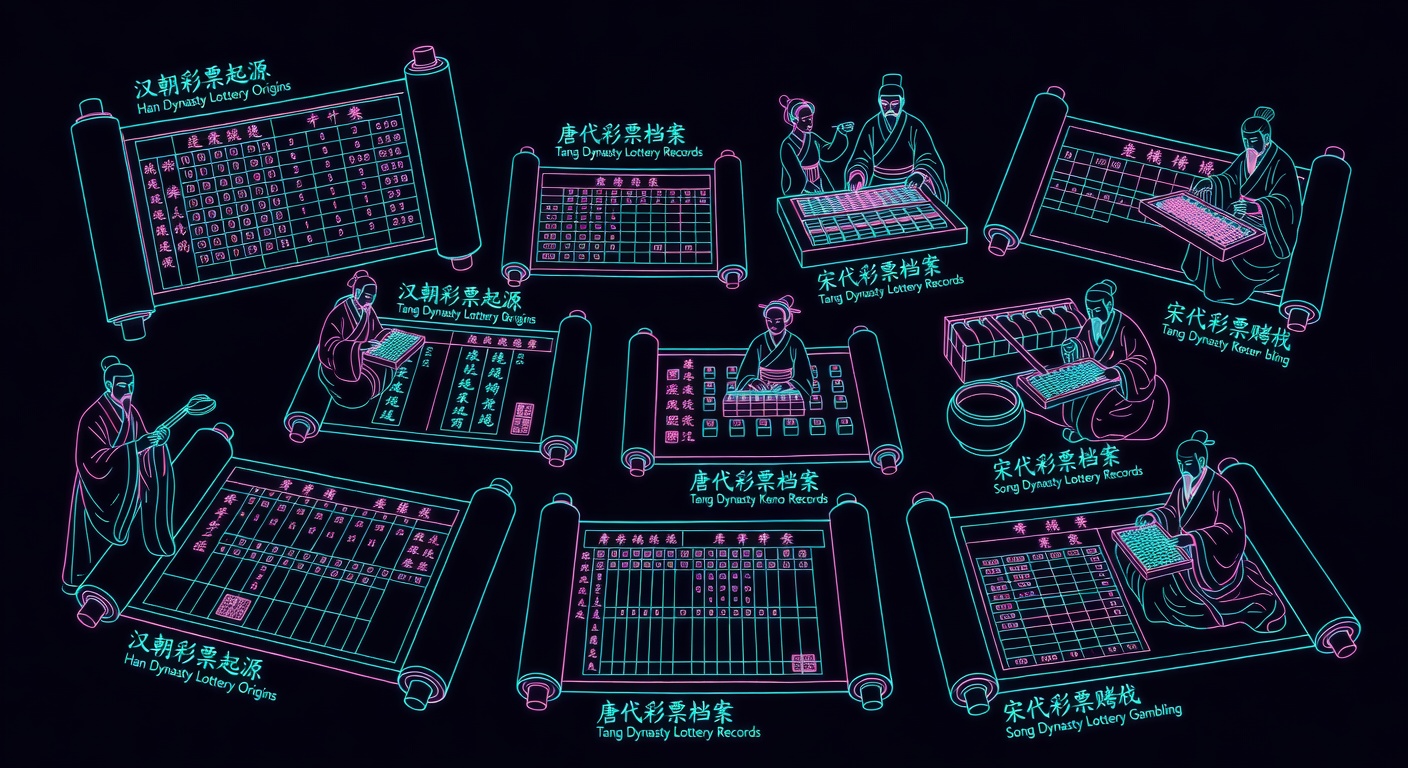
The door to the lane was narrow enough that a laden cart had to tilt sideways. Inside, past two turns, was a courtyard paved in grey brick. A bronze drum sat in the center, and around the drum were perhaps fifteen men, some standing, some on stools. They were not silent, but their voices were low. The drum held wooden slips. A keeper reached in, drew one, and read the number aloud. A merchant near the wall closed his eyes.
This is not a scene I witnessed. It is one I have reconstructed from fragments: Han dynasty administrative records, Song dynasty memorials to the throne, a pair of passages in the Shiji of Sima Qian, the observations of a Jesuit missionary in the seventeenth century who wrote at length about the lottery practices of the southern ports. The sources do not agree on every detail. They agree on enough.
The Chinese gambling tradition is the oldest documented continuous gambling tradition in the world. It begins before the common era and does not pause.
The Shang and Zhou Foundations
Bone divination, the earliest known gambling-adjacent practice in China, goes back to the Shang dynasty, roughly 1600 to 1046 before the common era. The oracle bones that survive in museum collections today are not strictly gambling artifacts. They are ritual divinations. But the line between divination and wagering, in a culture where the outcome of a cast predicts and sometimes determines an action, is not a hard line.
By the Warring States period, 475 to 221 BCE, something closer to recognizable gambling had emerged. Liubo, a game played on a marked board with six sticks used as dice, is depicted on tomb reliefs. The rules are lost. The betting was not incidental to the game. The Han ruler Wen, in 166 BCE, is recorded as having issued an edict discouraging excessive liubo play among officials.
What is worth noting, from the observer's chair, is that gambling in this period was already stratified. The literati played one set of games. The marketplace played another. The hierarchy of games mirrored the hierarchy of persons, and the official view of gambling depended heavily on who was doing it.
The Han Dynasty Lotteries
The first systems that resemble what we would now call a lottery appeared during the Han, 206 BCE to 220 CE. The word I am using, lottery, is anachronistic. The Han practice was called baige piao in some accounts, the white pigeon ticket, though this specific name is better documented for later dynasties. The principle, however, was there. A central authority issued tickets inscribed with characters or numbers. Purchasers matched their tickets against a draw. Winners received a payout, sometimes in cash, sometimes in grain, sometimes in other goods.
The earliest documented use of such a system for public finance appears in a passage attributed to the second-century minister Liu An, though the provenance is disputed by some sinologists. Liu An is said to have proposed a ticket-based revenue mechanism to fund the construction of a section of the Great Wall. Whether the proposal was implemented in his lifetime is unclear. What is clear is that by the late Han, lottery-style revenue devices were understood and occasionally deployed.
The slip ritual I described at the start is drawn from accounts of private lottery operations that proliferated in urban centers during the late Han and the subsequent Three Kingdoms period. They were not imperial. They were private. They often had quasi-legal status that depended on the disposition of the local magistrate. A merchant class, newly moneyed by the long stability of Han trade routes, found in the lottery a product that scratched a specific itch. The payout was large, the stake was small, and the administrative overhead was minimal.
The Tang and Song Refinements
The Tang dynasty, 618 to 907, saw gambling expand in parallel with urbanization. The great cities of Chang'an and Luoyang housed numerous gambling houses, which kept hours aligned with the market days. Dice games, tile games, and early card games all flourished. The proto-card game we would now associate with the origins of playing cards themselves emerged in this period. Some sinologists argue that the Western deck of cards descends, eventually, through a chain of Silk Road transmissions, from Tang dynasty money cards.
The Song dynasty, 960 to 1279, formalized state involvement. Ticket lotteries became a regular, though not continuous, tool of public finance. The Southern Song, after 1127, used lottery revenue to help fund coastal defense. The scale of these operations was substantial. Records from Hangzhou, the Southern Song capital, describe draws attended by thousands.
What the Courtyard Tells Us
Back to the courtyard. Back to the merchant who closed his eyes.
The practice as it existed, say, at the turn of the third century, was simultaneously a private entertainment, a social ritual, and a form of savings. The merchant staked a small amount weekly, sometimes in coin and sometimes in kind. The ticket was a receipt. The draw was a public event in the neighborhood. Winners were announced. The keeper of the drum kept a ledger. The ledger survived, when it survived at all, as a private document. Few have come down to us.
The sociality is the part I want to mark. Chinese gambling from the earliest records is not a solitary practice. It is a community practice. The player is embedded in a network of observers, fellow players, keepers, and local authorities. The outcome is not private. The outcome is announced, witnessed, and recorded. This persists, in modified form, across two thousand years. When I sat in a Fujianese association hall in Flushing, Queens, in 2017, watching men play a dice game I could not follow, the structure was the same. The stake was private. The outcome was public. The community held the memory of who won.
The first lotteries of ancient China were not financial instruments. They were social instruments that paid out, sometimes, in money. The merchant in the courtyard was not purchasing a chance at wealth. He was purchasing a place in the ledger of the neighborhood. When he opened his eyes and the number on the slip did not match, he was not, strictly speaking, disappointed. He had bought a week of waiting. He would buy another.
This is the long arc the sources point toward, imperfectly, in fragments. What we mean by lottery is a modern compression of something larger. The ticket was a receipt for belonging. The draw was the community's calendar. The win, when it came, was merely the moment the calendar turned.
Next notes
More from #history
The History of Bookmaking: From Ancient Rome to Modern Sportsbooks
People have been taking the other side of bets since money existed. The bookmaker is older than banks.

The History of Gambling in Ancient China and the First Lotteries
The earliest lottery system emerged not in Italy or France, but in ancient China, where gambling was embedded in ritual, governance, and military strategy simultaneously.

Sportsbook Licensing and Regulation: What Bettors Should Know
A licensed sportsbook is an audited, bonded, surveilled operation. An unlicensed one is an app that might vanish next week with your balance. The difference is not abstract. Here is what licensing actually means and why it matters.

How the Gambler's Fallacy Affects Roulette Players
Roulette teaches the human brain how to recognize patterns that don't exist. Understanding the design loop reveals why the game is so effective at it.

The Ultimate Guide to 3-Betting in No-Limit Hold'em
Three-betting is a specific technique used in poker to apply pressure. It worked the same way in organized crime investigations. Apply pressure, watch who cracks.

How to Play Small Pairs in Early Position
Analysis of 2.8 million hands shows that small pairs in early position succeed when played mechanically and fail when played by feel. The data is unambiguous on this point.