Jennifer Tilly: The Oscar Nominee Who Won a WSOP Bracelet
Jennifer Tilly won a WSOP Ladies Event bracelet in 2005, beating 600 players and taking home $158,625. Looking at her career as a designed onboarding path into poker reveals how the game absorbs a celebrity and what it gives back.

Jennifer Tilly won the 2005 World Series of Poker Ladies Event. She was an Oscar nominee for Bullets Over Broadway. She was also dating Phil Laak, a well-known professional. She finished first out of 601 entrants and took $158,625 and a gold bracelet. That is a bare summary.
What I want to do here is look at the run from a systems perspective. The poker world is, among other things, a onboarding and retention machine for new players, and celebrity players are a specific input into that machine. Tilly is a useful case because she entered, engaged deeply, and persisted. Most celebrity entries do not. Understanding why hers did is a design question.
The Input Profile
Before poker, Tilly was a working actress with a distinct public persona. Oscar nomination in 1994 for Bullets Over Broadway. Voice work in Bride of Chucky. A visible Hollywood profile without being a tabloid fixture. She came into poker through Phil Laak around 2003, during the post-Moneymaker boom when the game was absorbing an unusual volume of new players across every demographic.
Her entry loop looked like this:
- Social introduction via Laak, a low-friction first contact
- Casual home games, where mistakes are cheap and the teaching is unstructured
- Low-stakes casino play, introducing standard game flow and basic math
- Televised celebrity events, which normalized her visibility at the table
- Eventually, open-field tournament entry
This is a standard casual-to-engaged onboarding funnel, except compressed by celebrity. A non-celebrity player taking the same path typically spends two or three years in the middle steps. Tilly compressed it to eighteen months or so, because the exposure loops reinforced the engagement loops.
The 2005 Ladies Event as Retention Anchor
The bracelet win in June 2005 was not a one-off. It was a retention anchor. In game design terms, a retention anchor is a moment of validation that converts a casual player into a committed one. For most players, this is a first tournament cash, a first home-game win against a circle of friends, or a first recognizably correct strategic read.
Tilly's anchor was outsized. She beat 600 players in a structured event on the biggest stage in the game. The event itself was not a full open field; the Ladies Event is restricted to women, which has smaller fields than the Main Event. That does not diminish the validation. What it does, from a design standpoint, is provide an appropriately scaled ladder. A first bracelet at a Main Event would have been a retention anchor too large to integrate. A cash at a $1500 side event would have been too small. The Ladies Event was, by accident or design, the right rung.
She followed up with the 2005 WPT Ladies Night invitational, which she also won. The pattern of consecutive wins, each building on the previous validation, is a classic retention loop. The game was giving her a reason to come back.
Comparing Celebrity Entrants
This is where the comparison format earns its keep. Let me look at several other celebrity entrants into tournament poker from roughly the same era and ask why some persisted and some did not.
Tilly, 2005 to present. Sustained engagement. Cashes across nearly two decades. Notable high-stakes cash game visibility on the Live at the Bike broadcasts. Current engagement profile: committed recreational with some professional dimensions.
Ben Affleck, mid-2000s. Won the 2004 California State Poker Championship for $356,400. Cashed at the WSOP in subsequent years. Gradually reduced visibility. Current engagement profile: occasional high-stakes appearances, primarily social.
Tobey Maguire, mid-2000s to early 2010s. Deep cash game engagement, documented in the Molly Bloom account. High-stakes play at private LA games. Essentially exited publicly after 2011. Current engagement profile: withdrawn from public poker.
Jason Alexander, mid-2000s. WSOP Main Event bracelet presenter. Occasional cashes. Never reached the threshold of deep tournament engagement. Current engagement profile: lapsed.
Hank Azaria, 2000s onward. Moderate engagement. Preserved public profile as poker fan without becoming a grinder. Current engagement profile: stable recreational.
The pattern is that celebrities who had a retention anchor of appropriate size, and a social embedding in the community, persisted. Tilly had both. Affleck had the anchor but less community embedding. Maguire had neither in the public-facing sense. Alexander lacked the validating anchor. Azaria had social fit without the driving win and has maintained stable casual engagement.
A design table, if one is useful:
| Player | Retention Anchor | Community Fit | Persistence |
|---|---|---|---|
| Tilly | Strong (bracelet) | High (via Laak) | Sustained |
| Affleck | Strong (state championship) | Medium | Lapsed |
| Maguire | Private (cash games) | Private circle | Exited |
| Alexander | Weak | Medium | Lapsed |
| Azaria | None needed | Stable | Casual |
What Poker Gave Her
The loop that kept Tilly in poker looks like this from the design side.
She got validation at a public scale. She had a partner who was a professional, so the practice environment was high quality and close at hand. She found a public persona in poker that complemented her acting persona rather than competing with it. She became, in the ecosystem, a specific kind of fixture: the celebrity who actually plays, whom other pros treat as a peer rather than a novelty.
The rewards that kept her coming back were not, primarily, financial. The bracelet win was her highest cash, and the seventeen years since have included many cashes but nothing approaching the 2005 figure in real dollar terms. The rewards were participation in a community, continuing public profile that fed back into acting work, and the ongoing validation of being taken seriously at a skill game.
What the Game Took From the Celebrity Input
Tilly is also a net positive for the game itself. Her visibility drew viewers. Her credibility as both an actress and a competent tournament player modeled a kind of engagement that was otherwise hard to convey: poker as something an intelligent, successful, non-compulsive adult might do seriously for pleasure. In 2005 that model was still being built, and her presence contributed.
If the comparison produces a recommendation, it is this. For celebrity players who want to persist, the things that matter most are appropriate retention anchors and genuine social embedding. Tilly had both. She is still playing. Most of the 2005 cohort is not.
Next notes
More from #famous-players

Richard Marcus: The Infamous Past-Poster and Casino Cheat
Richard Marcus spent his life buying possibilities, not just in the lottery, but in the spaces between rules where people aren't looking.

Allen Iverson's Casino Bans: What the Reports Actually Say
Public records from Nevada gaming authorities show Iverson was excluded from casinos in 2012. The reasons were never fully disclosed, but the timeline reveals something about how exclusion actually works.

Kirk Kerkorian: The Quiet Billionaire Who Built Vegas Three Times
Kirk Kerkorian understood a fundamental truth about Las Vegas: the game is real estate, not gaming. Gaming is the excuse that gets people into the buildings.

Wayne Newton's Vegas Legacy and Casino Residencies
The entertainer spent more time in Las Vegas than most residents. Here's what his residency model tells us about casino hospitality architecture.
Daniel Negreanu: From Toronto Pool Halls to Poker Royalty
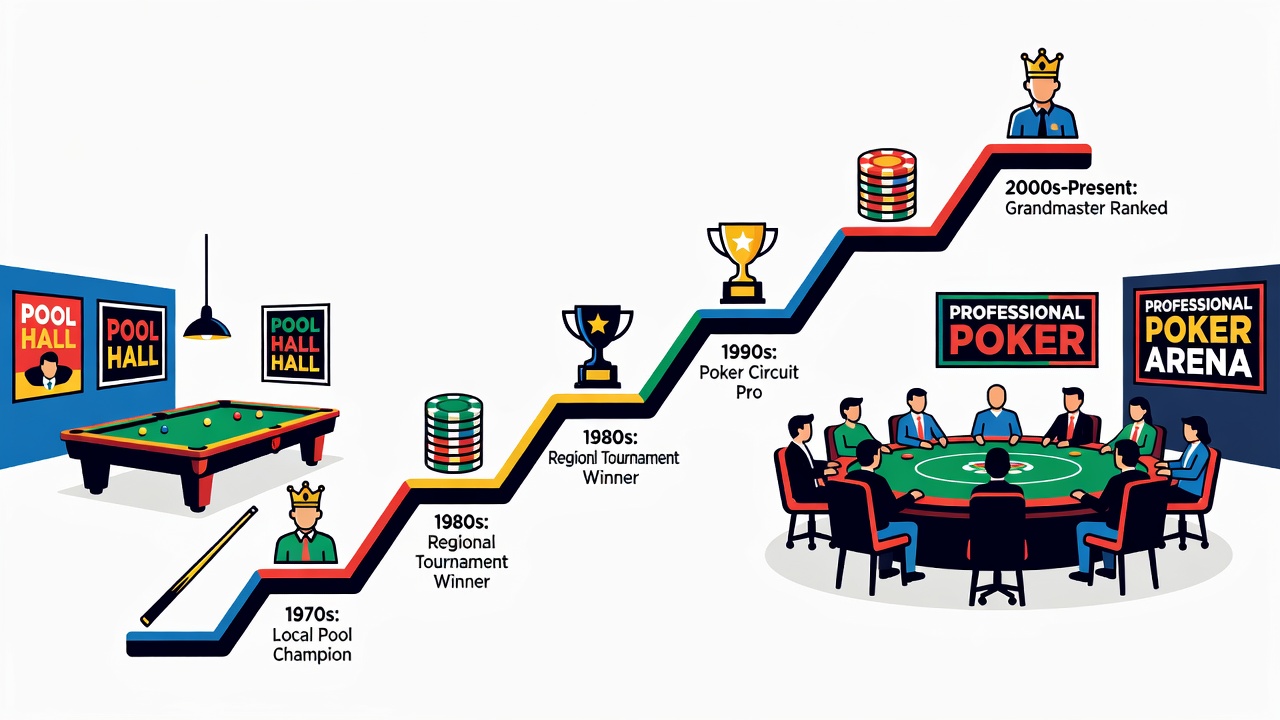
Daniel was shooting pool in Toronto in the early 1990s. Made maybe forty grand a year. By 1997, he'd figured out poker. By 2000, he was beating the best players in the world. That's a ten-year arc from regional operator to world-class grinder.

Tiger Woods and the High-Stakes Blackjack Tables of Vegas
Between 2000 and 2009, Tiger Woods was frequently photographed entering the casinos of Las Vegas. Public records show he gambled in private high-limit rooms. The amounts are documented. The outcomes are not.