Regular Season vs Postseason Betting: Adjusting Your Approach
The Aristocrat cabinets I worked on for forty years were consistent machines. The postseason betting environment is like comparing a well-maintained machine to one with a worn clutch. Same game, different dynamics.
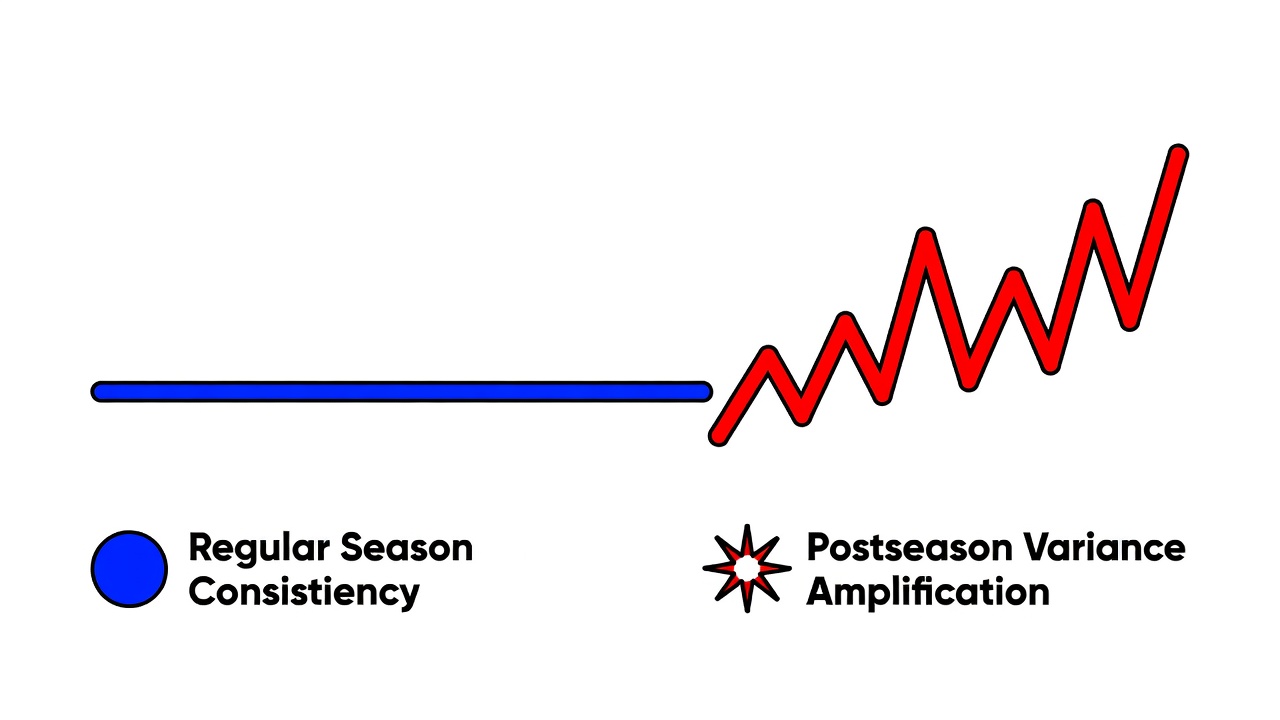
The Fundamental Difference
Regular season betting is predictable. Teams play 16 games. They establish patterns. A team that struggles on the road shows up in the data. A team that wins close games shows up. By week 10, you have real statistical information.
Postseason betting is a different animal. Teams play 4 to 5 games total. The sample size is tiny. All teams regress to their mean playoff performance. The patterns you identified in the regular season may not apply.
The Data Problem
In a 16-game regular season, a team plays 8 home games and 8 road games. You can measure home-field advantage. You can measure matchups. You can measure consistency.
In playoffs, a team plays maybe 4 games total. Conference Championships, Super Bowl. The sample size is so small that statistical inference is nearly impossible.
A team that went 14-3 in the regular season and was dominant at home played 8 home games. A confidence interval around their home performance is tight. In the playoffs, they might play 2 home games. The confidence interval widens dramatically.
Regression to Mean
The regulars who beat the postseason are the ones who understand regression to the mean.
A team that outperformed its record in the regular season (won close games, beat better teams) will typically regress in the postseason. They were lucky. The postseason has less luck. Better teams win more.
Conversely, a team that underperformed its record (lost close games, lost to worse teams) might regress back up. The postseason has fewer lucky breaks. Skill dominates.
Key Stats That Matter Postseason
In the regular season, I track third-down conversion rate, red zone efficiency, time of possession. These matter.
In the postseason, concentrate on:
-
Turnover margin. Postseason games are decided by mistakes. Teams that take care of the ball win more.
-
Red zone efficiency. The field gets smaller. Execution in tight spaces matters more.
-
Coaching adjustments. The same gameplan doesn't work twice. Coaches who adjust on the fly win.
-
Special teams. Postseason games are often decided by small margins. Field goals and coverage units matter disproportionately.
Narratives vs Data
Postseason betting is prone to narrative-driven betting. A team that just beat a divisional rival in a thrilling game carries momentum. The narrative is powerful.
But narratives are not predictive. A team that beat the 2-seed by 3 points in round one has no statistical advantage in the next round. The narrative of "momentum" is seductive and false.
The mechanics are what matter: turnovers, efficiency, coaching quality.
The Favorites
In the regular season, favorites win about 62% of games. In the postseason, favorites win about 68% of games.
Why? Because the postseason is a tournament of equals. The worst team in the postseason would have been 10-6 or better in the regular season. The gap between first and last is narrower.
But the best teams in the postseason are genuinely the best. The 1-seed is the 1-seed for a reason. In a short sample, the best team usually wins.
The Contrarian Angle
Most casual bettors overvalue narrative in the postseason. They bet on momentum, on Cinderella stories, on underdogs.
This creates an opportunity: play the fundamentals. Bet on the team with better turnover margin. Bet on the team with better third-down conversion rate. Bet on the team with better red zone efficiency.
These are unsexy bets. But they're more predictive than narratives.
The Bankroll Consideration
Postseason betting variance is higher. Fewer games means fewer opportunities to let the law of large numbers work in your favor.
If you have a 55% win rate on regular season bets, you might make 150 bets over 16 weeks. Variance smooths out. Over 150 bets at 55%, you'll be profitable.
In the postseason, you might make 30 bets. At 55% win rate, the variance is larger. You might win-or-lose 5 to 10 units even if your edge is real.
Adjust bankroll accordingly. Smaller bets. Tighter discipline.
The Honest Take
Postseason betting is harder than regular season betting. The sample sizes are small. The field is strong. The lines are efficient.
The profitable approach is mechanical: identify teams with edge-indicating stats, bet them consistently, accept the variance, and let long-term results emerge.
Next notes
More from #reviews

Favorite vs Underdog: When the Chalk Is Actually Worth It
Sports betting wisdom says take the underdog. But sometimes the favorite is correctly priced and the public is wrong in the other direction.

Best Slot Themes for Fans of Ancient Mythology
The gods don't play. They don't need to. But people who believe in them do. They spin wheels decorated with Zeus, Osiris, Thor, hoping to touch something larger than themselves. That's what mythology slots sell.

How the Gambler's Fallacy Affects Roulette Players
Roulette teaches the human brain how to recognize patterns that don't exist. Understanding the design loop reveals why the game is so effective at it.

Mattress Mack's 75 Million Dollar Astros World Series Win
Jim McIngvale's 75 million dollar World Series bet in 2022 represents a rare intersection of narrative and reinforcement learning. What it reveals about gambling behavior.

The Ultimate Guide to 3-Betting in No-Limit Hold'em
Three-betting is a specific technique used in poker to apply pressure. It worked the same way in organized crime investigations. Apply pressure, watch who cracks.

How to Play Small Pairs in Early Position
Analysis of 2.8 million hands shows that small pairs in early position succeed when played mechanically and fail when played by feel. The data is unambiguous on this point.