Tournament Blackjack: How Elimination Rounds Differ From Cash Play
In cash blackjack, you're optimizing for long-term wealth accumulation. In tournament blackjack, you're optimizing for position relative to competitors. The math is different. The strategy is different. Many players don't adjust.
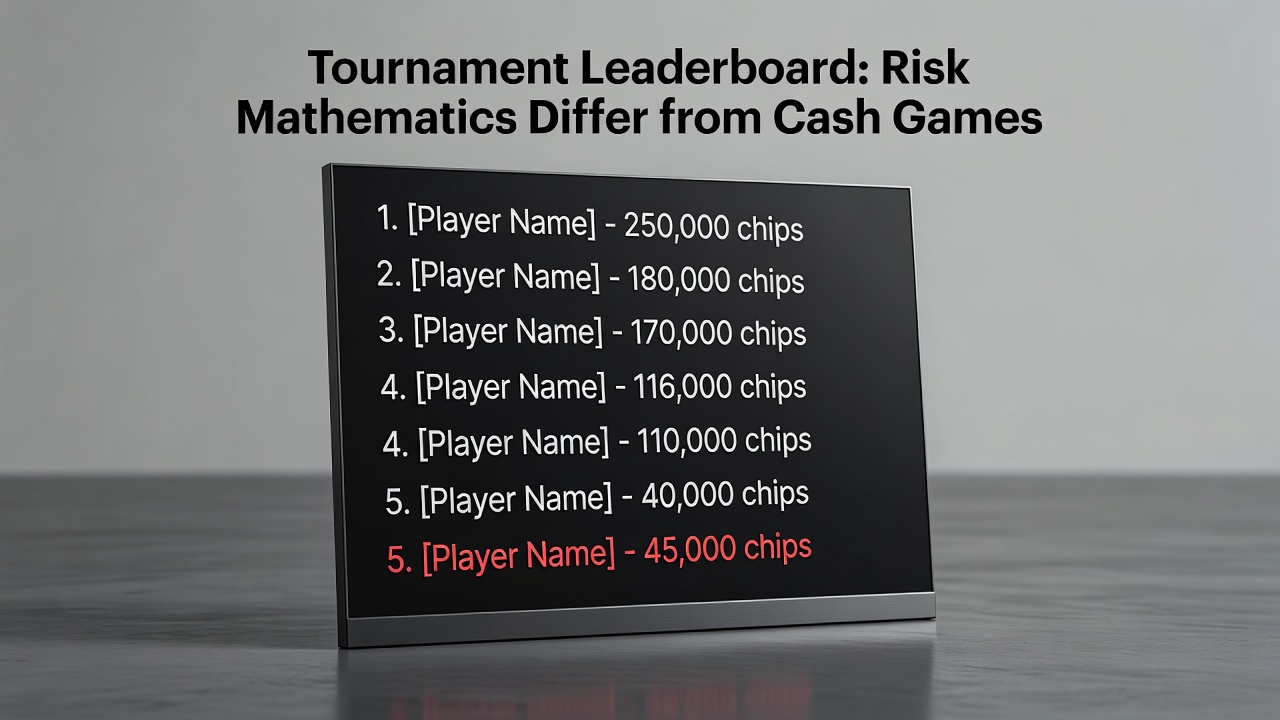
The Fundamental Difference
In cash blackjack, your goal is maximizing expected value. You play basic strategy because it maximizes your expected return per hand. Your individual hand results don't affect anyone else. You're trying to win money against the house.
In tournament blackjack, your goal is finishing in the top positions relative to other competitors. The absolute chip count matters less than your position in the standings. Other players' results affect your equity directly.
This creates a strategic environment completely different from cash play.
Hand-by-Hand Strategy
Early Tournament Rounds
In early rounds, you're not under pressure. The payout structure rewards top finishers, not survival. Many players survive early rounds.
Your strategy here should be conservative. Play tight. Preserve chips. Let others bust out. The reasoning: in multi-table tournaments, early eliminations happen frequently. By playing carefully, you ensure you don't eliminate yourself.
This differs from cash play. In cash, there's no "good" hand to play early. You maximize EV regardless of position. In tournament, you can afford to fold marginal hands early because chips are abundant and the field is large.
Bubble Play
The bubble is where tournament strategy diverges most dramatically from cash strategy.
Let's say the tournament pays the top 9 finishers. 10 players remain. One player is short-stacked (has very few chips). That player is likely to bust out on the next hand or soon after. Once they bust, the remaining 9 players are in the money.
If you're chip-heavy, you should be attacking the short stack. Push them out. Force them to make a decision with limited chips. Your goal is eliminating them quickly so the rest of the table is in the money.
If you're short-stacked, you should be looking for any hand to go all-in. Your survival probability is very low. You need chips or you bust. Pushing with marginal hands is correct strategy, even though it's terrible cash game strategy.
If you're medium-stacked, you should be folding to the aggression of the chip leader but playing selectively against other medium and short-stacked players.
This is completely opposite to cash blackjack, where hand selection is independent of chip position.
Final Table
Once at the final table, the payout jumps are large. The difference between 9th and 8th might be substantial. This creates risk aversion.
If you're barely at the table and another player is short-stacked, your strategy is to play tight and let them bust. If you're chip leader, your strategy is to aggressively attack other players and build a runaway lead.
Psychological Factors
Tournament play is psychologically different than cash play. In cash, a bad hand is just variance. In a tournament bubble, a bad hand can eliminate you.
This creates higher emotional stakes. Players tighten up. They fold more hands. They're more risk-averse. This is observed as documented behavioral pattern in tournament settings.
Research in behavioral economics (Thaler, 1999; Kahneman & Tversky, 1979) shows that people are loss-averse under pressure. When facing elimination, they tend toward conservative play.
Good tournament players exploit this. They apply pressure when chip-heavy, forcing tight opponents into bad situations. They play loose when short-stacked, knowing tight opponents will fold.
The Shift in Hand Selection
In cash blackjack, you hit stiff hands because the mathematical expectation supports it. In tournament blackjack, context matters.
Let's say you're short-stacked on the bubble with 12 versus the dealer's 6. In cash, you stand because the odds favor standing. In tournament, you might double down even though it's mathematically worse, because you need to grow your stack quickly to avoid elimination.
The tournament structure makes inferior mathematical plays superior strategic plays.
The Learning Implication
Many blackjack professionals who excel at cash play fail at tournament play. They optimize for EV, not position. They don't adjust their strategy based on chip counts and payoff structures.
The reverse is also true. Tournament specialists sometimes struggle in cash games because they're over-aggressive and under-adjusted for mathematical reality.
The best tournament players are the ones who understand both systems and switch between them seamlessly.
Next notes
More from #blackjack
Best Ways to Practice Blackjack Strategy Before Playing for Real
Demonstrates why most people fail at this activity. best ways to practice blackjack strategy before playing for real requires both knowledge and discipline.
The Kelly Criterion Applied to Blackjack Bet Sizing
The Kelly Criterion is a formula for optimal bet sizing. Blackjack has an edge. Apply Kelly and you get bet sizes that change dynamically.

Beat the Dealer: Edward Thorp's Book That Changed Gambling
Edward Thorp proved that a game with rules could be beaten. Not through luck, through mathematics. What does this tell us about games in general.

The MIT Blackjack Team: How Card Counters Beat the House
The MIT Blackjack Team made millions counting cards. They were not geniuses. They just understood the math better than the casinos did.

The Birth of Nevada Gambling: The 1931 Legalization Explained
On March 19, 1931, Nevada legalized gambling to raise tax revenue during the Great Depression. The move created an industry that has not stopped growing. No state has ever successfully banned gambling after legalizing it.

Johnny Chan: The Orient Express and His Back-to-Back WSOP Wins
Johnny Chan won the WSOP Main Event in 1987 and 1988. Back-to-back. No one had done it before. No one has done it since. He earned the nickname The Orient Express for playing fast and never showing weakness.