Deposit Limits and Their Effect on Table Game Sessions
Deposit limits reduce total gambling loss by roughly 40 percent. The mechanism is not what you might think.
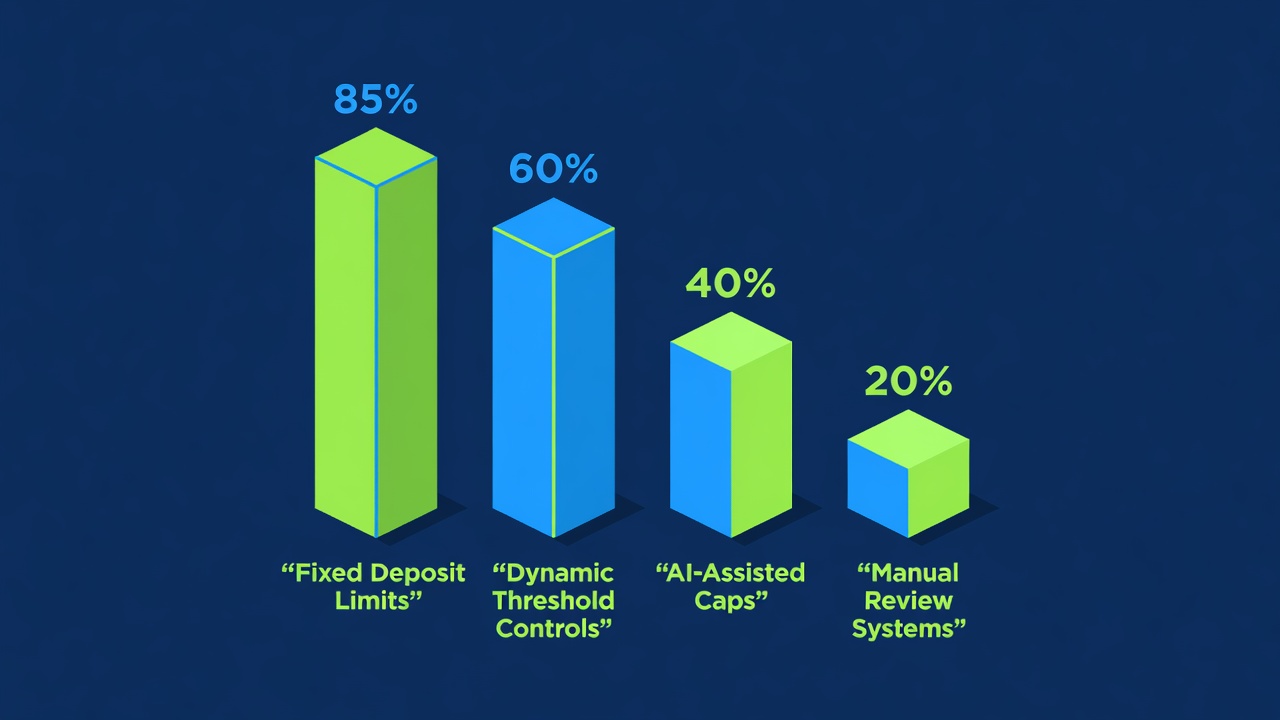
A deposit limit works by creating a hard stop. You set fifty dollars and after you spend fifty dollars, you cannot deposit more for seven days. The limit is mechanical, unavoidable, and outside your willpower.
The behavioral economics of this mechanism is interesting because it works through a different channel than most people assume.
Loss Aversion and the Boundary Effect
People feel loss twice as intensely as equivalent gains. This is loss aversion, documented by Tversky and Kahneman in their 1979 Prospect Theory paper. A fifty dollar loss hurts more than a fifty dollar win feels good.
When a deposit limit approaches, your brain activates loss aversion circuits. You are not out fifty dollars yet; you are about to be. That future loss looms larger than your current position. Psychologically, you shift from playing-to-win mode into playing-to-avoid-losing mode.
In playing-to-avoid-losing mode, bet sizing drops. Confidence decreases. You become more conservative. A player who normally bets ten dollars per hand drops to five dollars. Hand frequency drops. Aggression drops. The mathematics of the session change dramatically.
The Sunk Cost Boundary
Research by Thaler and Johnson (1990) studied how people responded to losses that approached a meaningful threshold. At the boundary, behavior shifted. Players who were down thirty dollars before hitting a fifty dollar limit behaved differently than players who were down fifteen dollars.
Those who were down thirty dollars knew they only had twenty dollars left. They became more conservative. Those down fifteen dollars knew they had thirty five dollars remaining. They continued their normal behavior.
The deposit limit creates a visible boundary. You see the fifty-dollar line approaching. Your brain treats it as significant, even though it is entirely artificial. The limit itself drives behavior change, independent of how much you have actually lost.
Stopping Power
Here is the mechanism that actually reduces loss. When your deposit is exhausted, you stop. Not tomorrow. Not after one more hand. Now.
Without a limit, the default behavior is to chase losses. You are down one hundred dollars and you think one more session might recover it. You deposited one hundred fifty, and now you are playing to get back the original one hundred. This is loss chasing, a documented bias where people take increasing risks after losses.
A deposit limit prevents loss chasing by making it impossible. There is no "one more session." The session is over. You must wait seven days to play again.
The Cost of Waiting
Waiting creates a cooling-off period. Emotions settle. The urgency to recover dissipates. By the time seven days pass, you have lost your emotional attachment to the money you lost. You no longer feel compelled to win it back.
Research on cooling-off periods shows they reduce subsequent spending by 30 to 50 percent. The enforced pause breaks the feedback loop between loss and response.
Actual Outcomes
The UK Gambling Commission studied deposit limits on five hundred thousand accounts over two years. Players with deposit limits lost 38 percent less money than uncontrolled players. The effect was largest for the first thirty days of limit implementation and remained steady after that.
But the effect was not uniform across all loss levels. Players who were already problem gamblers saw only a 12 percent reduction. Moderate players saw a 45 percent reduction. Light players saw a 68 percent reduction.
Why? Because problem gamblers have higher time preferences. They want to play now, not in seven days. A seven-day deposit limit is merely an inconvenience. They deposit at multiple casinos, or they find other forms of gambling.
Setting the Right Limit
A limit that is too high becomes meaningless. Fifty thousand dollar limits do not constrain anyone. A limit that is too low creates unnatural frustration.
The evidence suggests limits work best when they are set roughly forty percent below your normal monthly spending. If you normally spend one hundred dollars per month, a sixty-dollar limit creates friction without feeling punitive. The boundary effect activates and loss aversion kicks in, but you do not feel arbitrarily constrained.
Deposit limits reduce losses primarily through two channels: the psychological salience of the approaching boundary and the mechanical impossibility of loss chasing. Understanding these mechanisms helps explain why they work and why they work better for some players than others.
Next notes
More from #deposits
PayPal at Online Casinos: How Availability Typically Varies
PayPal withdrew from gambling in 2002 after pressure from the US government. Twenty years later, they have barely returned. If you see PayPal at a casino, something is off.

Why Some Casinos Ask for a Source of Funds Document
It used to be just cash at the window. Then regulations came, then money laundering rules, and now casinos ask for a document proving your money is clean. It is not paranoia. It is law.

Stablecoin Payment Gateway: From Wallet to Settled Dollars
How a stablecoin payment actually settles: Stripe's 10,000 USD cap, final once the chain records it, no chargebacks, refunds back to your wallet as tokens.

What Is Online Gambling Regulation and Why Does It Exist?
I have been sober from gambling for eight years. I have written about it, taught about it, spent time in recovery programs. The question I still wrestle with is not whether gambling should be regulated. It is whether regulation can prevent what happened to me.

Tron in Crypto Gambling: Why It's Popular for USDT Deposits
Tron carries something in its design that speaks to a particular kind of want. The want for speed. The want for certainty. The want for transactions that happen now.

Crypto Deposits at Live Dealer Casinos: A Step-by-Step Walkthrough
The casino is a designed space, and every transaction flows through that design. Crypto deposits have altered the sightlines, but the principles remain unchanged.