Polarized vs Merged Ranges in Poker Explained
I watched a dealer explain range theory to a tourist in 1987 and he had no idea what she was talking about. Now every serious player understands it. Here is how it happened.
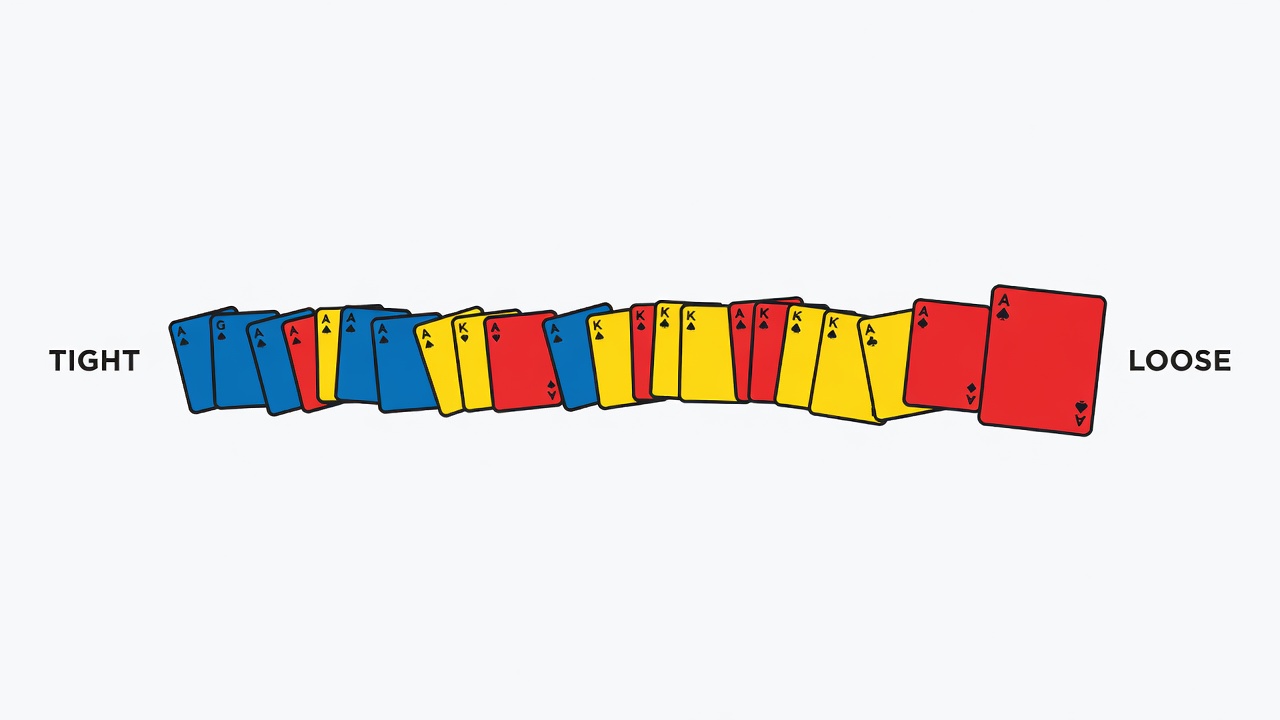
Range theory did not exist in poker until computers started mapping it out. In the eighties, you bet strong hands and weak hands for value, or you bluffed. You did not have a theoretical framework for the mixture. You just played.
The first computer solvers showed something surprising: the optimal way to play poker requires you to polarize your range. That is, you raise the very strongest hands and the weakest hands, and you fold or call the medium hands. This seems backwards until you think about what your opponent is trying to do. If you only raised with strong hands, they would fold everything mediocre and call with monsters. You would lose chips every time you bluffed. If you raised some medium hands too, you made your raising range harder to exploit.
The Structure of Strength
Polarization means your betting line tells a story. If you raise preflop and then check the flop after an ace comes, your range is now very specific: you have either a pocket pair or a suited connector that missed. You do not have ace-king or queen-queen, because you would bet those. Your opponent can now play very precisely against you.
A merged range is the opposite. You are betting strong hands, medium hands, and weak hands in roughly equal proportions. You are merged because your line does not narrow your hand much. An opponent cannot easily deduce what you hold.
I dealt poker from 1982 to 1991 and I never heard anyone say the word polarized. The thing existed in the structure of the game, but the vocabulary was not there. Good players got lucky because they were balancing their ranges intuitively. Bad players played polarized without knowing it, which is why they were exploitable.
How This Changed the Game
In the nineties, Chris Ferguson published some work on GTO poker. The language shifted. By the early two-thousands, every poker book started talking about ranges. By the time online poker exploded, every serious player was thinking in terms of their range and their opponent's range.
This changed everything about how the game was played. Tournaments became more aggressive because players understood that merging their range allowed them to steal more. Tighter play, which used to be respected, became exploitable. A player who only raised premium hands was a gold mine for anyone smart enough to attack his folding range.
I saw this evolution in real time. The 1987 WSOP Main Event involved a lot of tight play and big hands having big confrontations. The 2007 WSOP Main Event was range wars. Players were three-betting light, four-betting bluffs, and checking back medium-strength hands because the GTO mathematics said so.
Where We Are Now
Every poker player above a certain skill level understands range theory. The question now is not whether to polarize or merge, but when and how much.
In heads-up play, polarization dominates. You do not have the luxury of medium hands that win by default because your opponent is wide. You must be extreme.
In six-max or full-ring, merging is more profitable. You have more opponents, and a merged range allows you to win more pots on the flop and turn.
The best players now move fluidly between the two. They polarize when the situation demands it. They merge when the board texture and opponent pool makes merging more profitable. This is the difference between a competent player and a great one: the great player has internalized range theory enough to know when to break it.
I remember a hand in 1998 where a player folded a full house because he thought he was beat. He did not have the language of range theory to explain why he folded, but he was thinking about his opponent's range anyway. Now that same reasoning is taught in books, blogs, and poker courses. The sophistication of the game has compounded.
The wheel is not stopping. The next evolution is probably already happening in the training rooms of the best players. In ten years, there will be another vocabulary shift, another framework for how to think about poker. The game is always becoming more complex and more precise. That is the only constant.
Next notes
More from #how-to

The Ultimate Guide to 3-Betting in No-Limit Hold'em
Three-betting is a specific technique used in poker to apply pressure. It worked the same way in organized crime investigations. Apply pressure, watch who cracks.

How to Play Small Pairs in Early Position
Analysis of 2.8 million hands shows that small pairs in early position succeed when played mechanically and fail when played by feel. The data is unambiguous on this point.

Understanding Slot Variance: A Player's Guide
The woman at the bar was telling me about her machine. She had played it every day for five years. She had never won anything significant, but she could not stop.

What Is Online Gambling Regulation and Why Does It Exist?
I have been sober from gambling for eight years. I have written about it, taught about it, spent time in recovery programs. The question I still wrestle with is not whether gambling should be regulated. It is whether regulation can prevent what happened to me.

How to Bet NBA Player Props the Smart Way
Player props are absolutely insane right now. Seriously. And actually, there's a way to think about them that doesn't involve losing your entire bankroll by halftime.

How to Beat Low-Stakes Online Poker Games
Winning at poker depends on understanding a specific distribution: the gap between your win rate and the average player's in your stakes.