HUDs in Online Poker: What the Stats Actually Mean
A HUD is a small pane of glass. What is shown on it, and in what order, is a design decision as deliberate as the sightlines in a Friedman-era casino. Understanding the stats is the cheap part. Understanding why they are arranged as they are is the work.
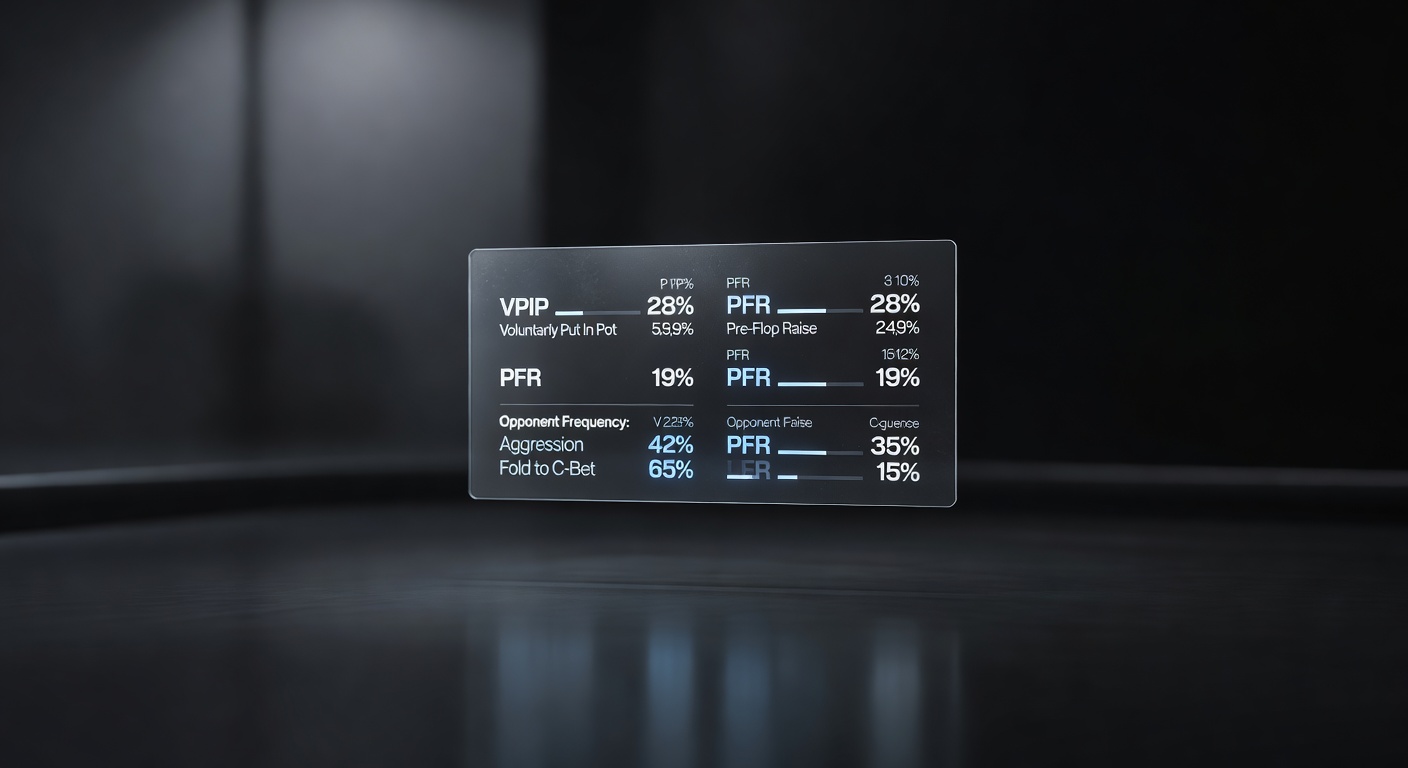
The HUD is a piece of architecture. It sits on the edge of a virtual table and it governs the player's attention the way a pit boss's sightline governs a pit. The pane is usually three inches wide and an inch tall. Four to eight numbers live inside it. Which numbers, and where, and in what colour, decides how a grinder plays the next hour.
The Building Blocks
A HUD displays statistical profiles of each opponent, drawn from a database of observed hands. The standard set, near universal across Hold'em Manager 3 and PokerTracker 4 configurations, consists of:
- VPIP, voluntarily put money in pot, the share of hands a player voluntarily enters
- PFR, preflop raise, the share of hands a player raises preflop
- 3-bet, the share of open-raised pots a player re-raises
- Fold to 3-bet, the share of times a raiser folds to a re-raise
- Aggression factor or aggression frequency, some measure of postflop raising behaviour
- Cbet, continuation bet on the flop after preflop raising
- Fold to cbet
- Hands sample size, which tells you how much to trust the other numbers
Each is a percentage, except aggression factor. Each requires a minimum sample size before it is meaningful. A VPIP number over a hundred hands has some signal. A 3-bet number over a hundred hands has almost none.
Why the Arrangement Matters
The first number a grinder looks at, in almost every HUD layout I have surveyed, is sample size. Without it, every other figure is a decoration. This is why Kiener, the man who designed much of the original Hold'em Manager layout logic, placed it in the leftmost position in the default template. The same reasoning that puts the cage in direct sightline from the front entrance of a Friedman-era Las Vegas casino, the one Bill Friedman wrote about in his 1982 text on casino layout, governs the arrangement of pixels in a HUD. The eye finds the anchor first.
After sample size, the eye moves to VPIP and PFR. The ratio between them tells a player almost everything about how loose or tight an opponent plays, and how aggressive they are relative to how loose they are. A 24 over 20 is a standard reg. A 50 over 8 is a fish who calls too much and does not raise. A 30 over 28 is a maniac. These patterns are as readable as the carpet pattern in a high-limit room, and they drive decisions just as strongly.
The Third Tier: Situational Stats
Once the player type is established, the grinder reads the situational stats. 3-bet percentage reveals opening range tightness, because a player who 3-bets at 10 percent is flatting too much, and at 2 percent is folding too much. Fold to 3-bet reveals whether a light 3-bet is profitable. Cbet reveals whether the preflop raiser is bet-happy or selective on boards they did not connect with.
The arrangement of these numbers in the HUD is again a matter of architectural priority. Most grinders group preflop stats on the top row and postflop stats on the bottom row, because decisions flow in that order. The eye travels left-right, top-bottom, in the same arc it travels through a well-designed casino floor. This is not an accident. Both designs owe to the same body of work on visual scanning, much of which originated in airport signage research in the 1970s.
What the HUD Cannot Show
A HUD is a static pane of glass. It shows aggregate behaviour, not the current narrative. The opponent's mood, recent stack swings, tilt state, the dynamics of the past fifteen hands, none of this appears on the HUD. A player who relies on the numbers without reading the table is using a set of blueprints without visiting the site.
This is why the best grinders I have watched treat the HUD as a quick reference rather than a primary input. They read the numbers once per hand, at the moment of decision. They do not stare at the HUD the way a slot player stares at a reel. They use it the way an architect uses a scale drawing, as confirmation of what the site walk already told them.
The Ethical Architecture
There is a live debate in the online poker community about whether HUDs should be permitted at all. Several sites, notably PokerStars in 2019, have restricted third-party tracking software or banned specific features. The argument is about fairness. A player with a HUD has an information advantage over a player without one. This is true. It is also true that a casino with a security lounge has an information advantage over the floor. Architecture is almost always an asymmetric tool.
The HUD is a building. It is small, and its rooms are numbers. What you put in it, and how you arrange it, changes the behaviour inside. That is the whole craft.
Next notes
More from #poker
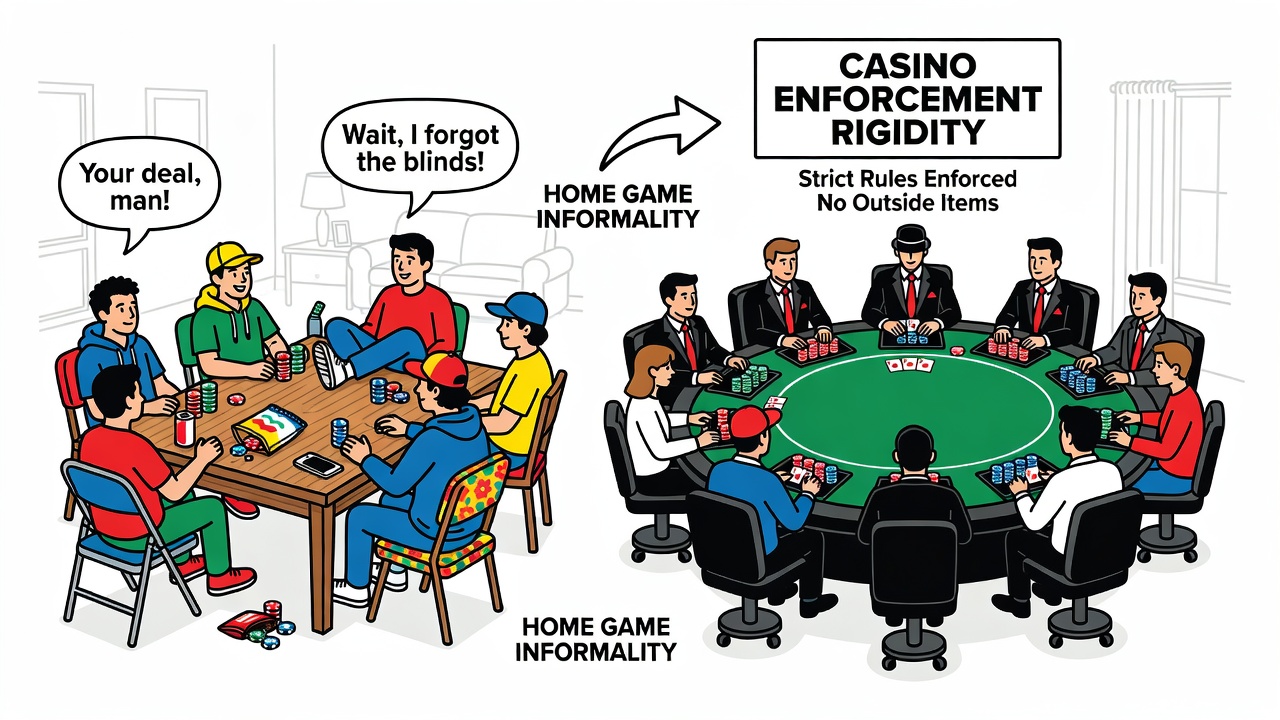
How Home Poker Games Differ From Casino Cash Games
A careful examination of the legal, social, and mathematical differences between home poker and casino cash games reveals that the similarities are often overstated.
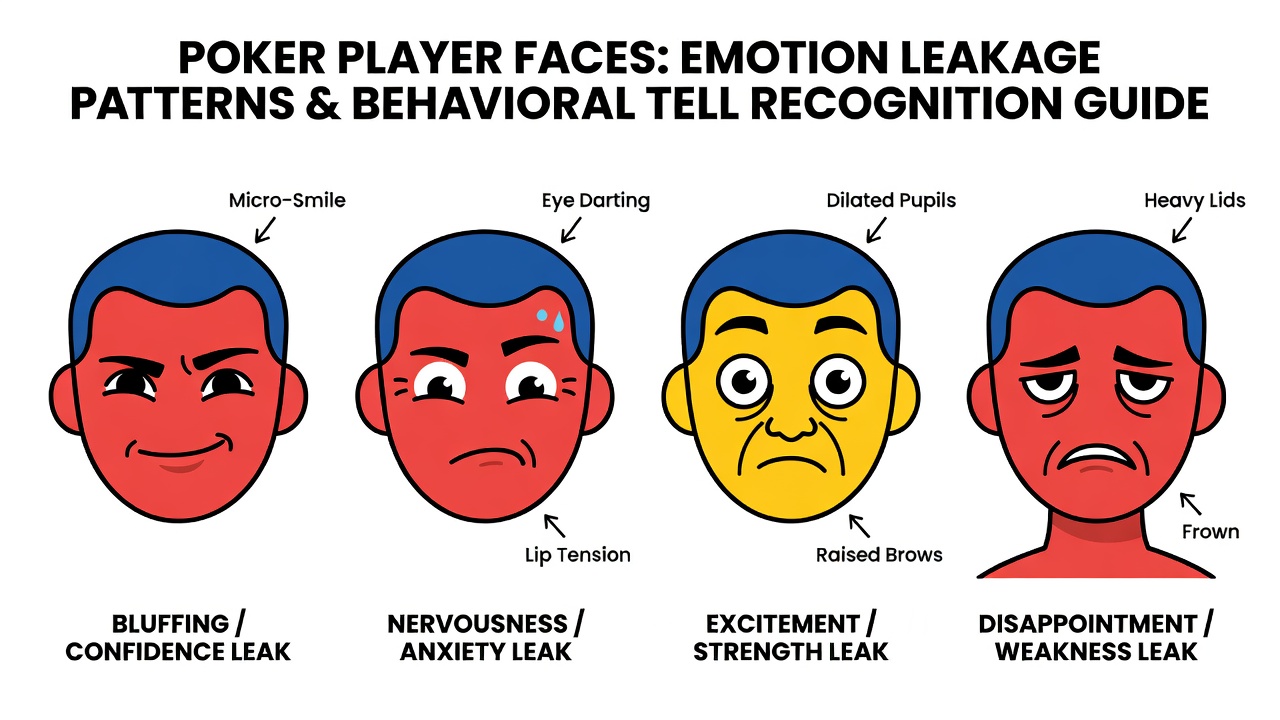
Poker Tells in Live Games: What to Watch For
A tell is a behavioral pattern that reveals hand strength. Poker players are trying to mask their emotions. The tells emerge from the parts they forgot to mask.
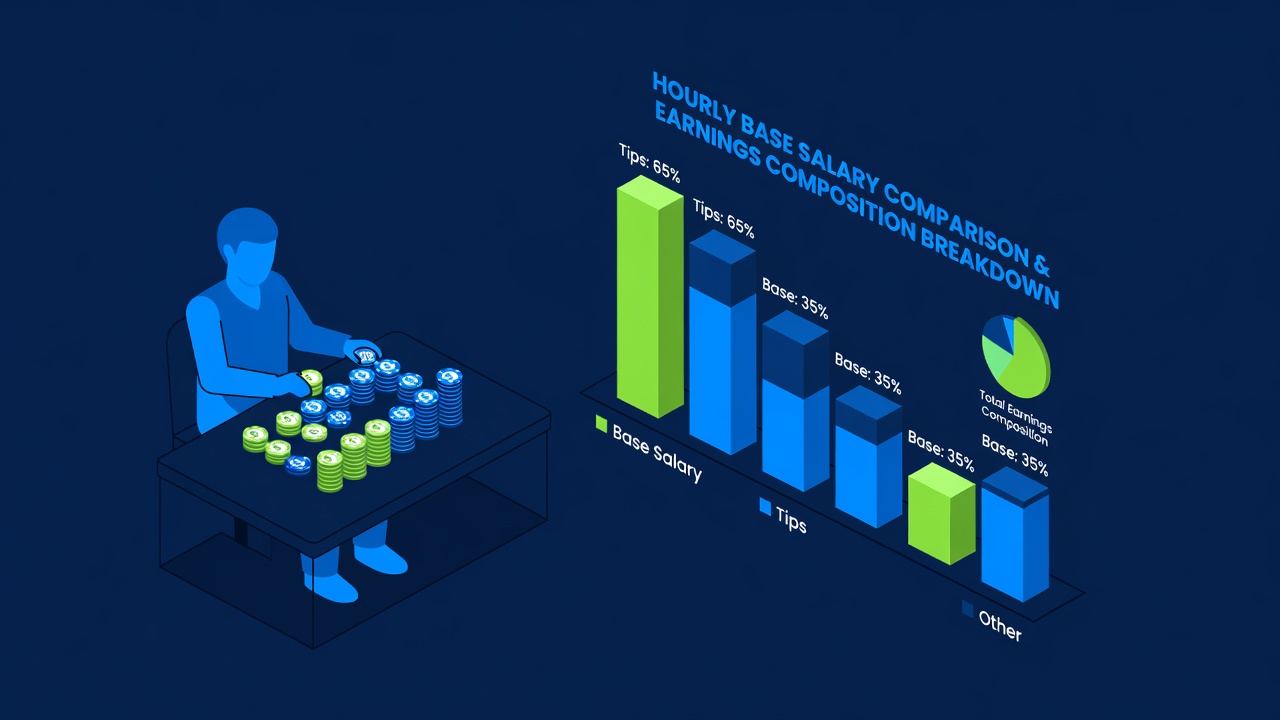
Tipping Dealers in Live Poker: What's Appropriate
A dealer working five hours on a Tuesday afternoon at a regional poker room makes maybe $200 in base salary. Everything else is tips. This changes how you understand the relationship between player and dealer.
Poker Night TV: The Rise and Fall of Televised Poker on ESPN
ESPN started broadcasting poker in 2003. For five years, it was the most watched non-sports programming on the network. Then it disappeared. The moral is that even good things end when people stop watching.
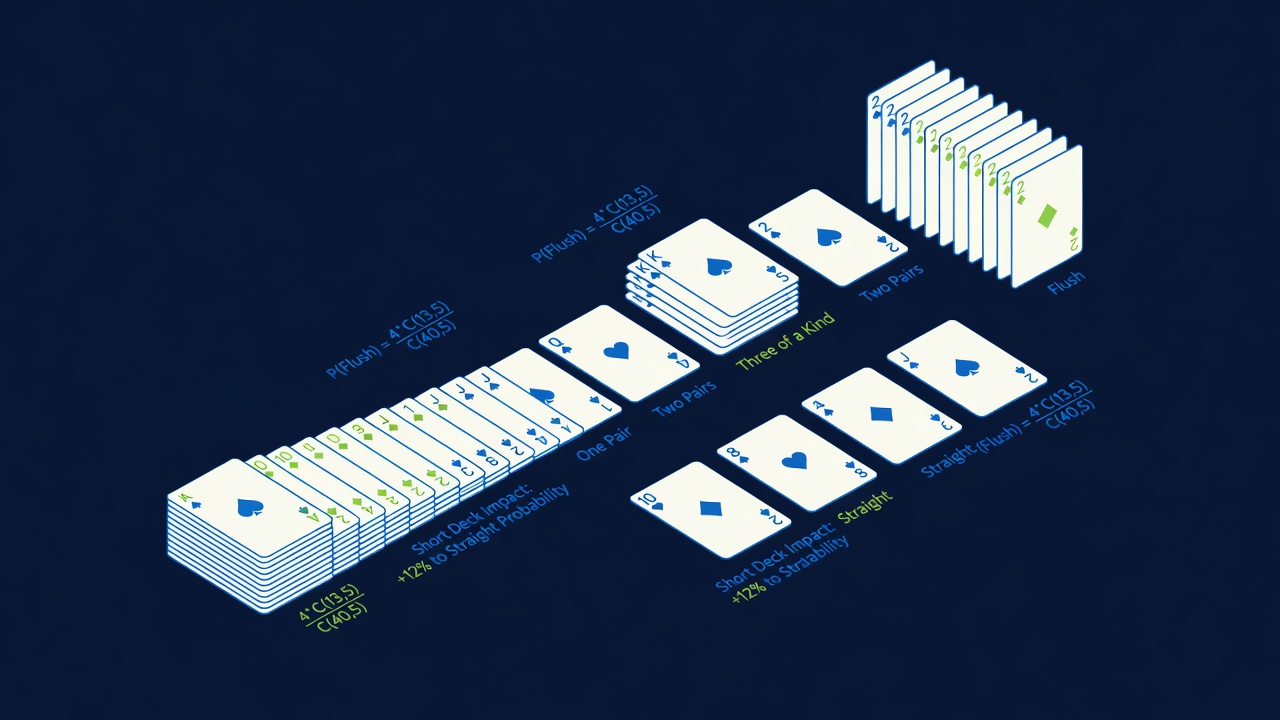
Short Deck Hold'em: Rules and Starting Strategy
Short deck removes the twos through fives. The math changes. Your hand values shift. Here is what adjusts.
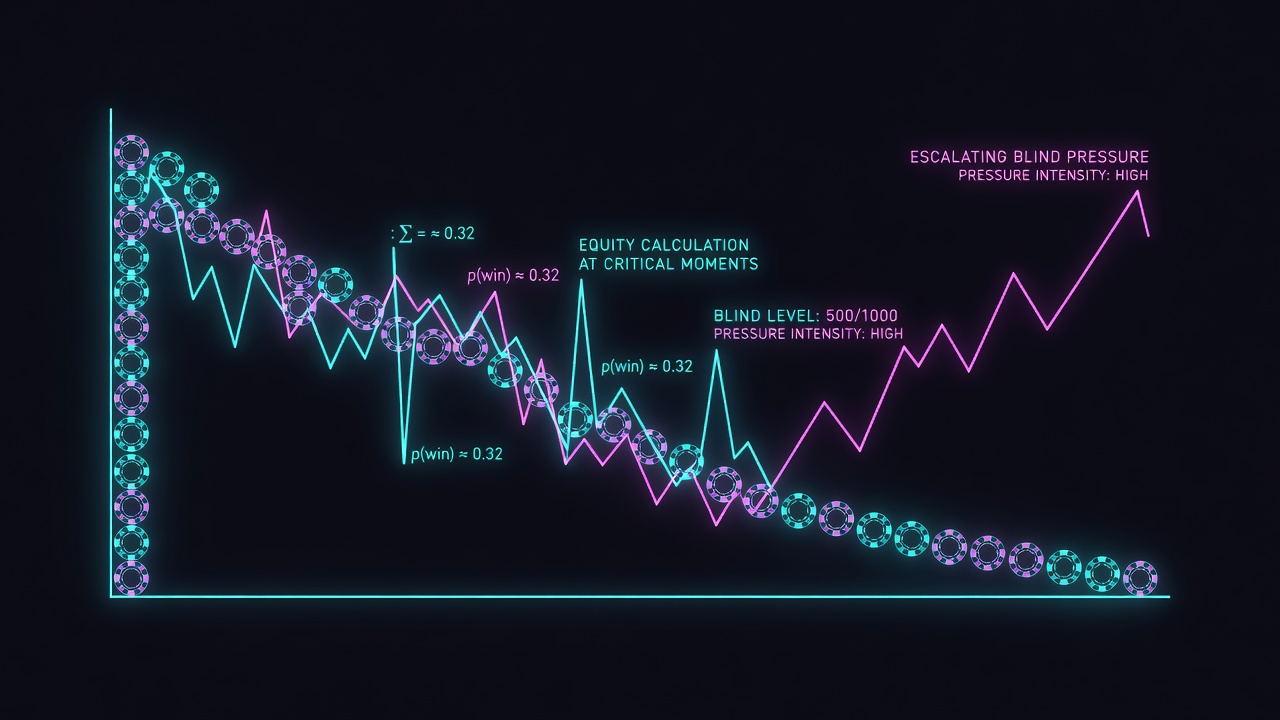
Short-Stack Strategy for Poker Tournaments
When the blinds have eaten your chips down to a whisper, the game changes. A dealer I worked with in Macau explained this better than any poker book ever could.