Live Dealer Chat: Unwritten Rules for Players
The live dealer chat is a parallel universe with its own hierarchy. The dealer is sovereign over the table. Players have status based on bet size and behavior. There are unwritten laws about tipping, aggression, and respect.
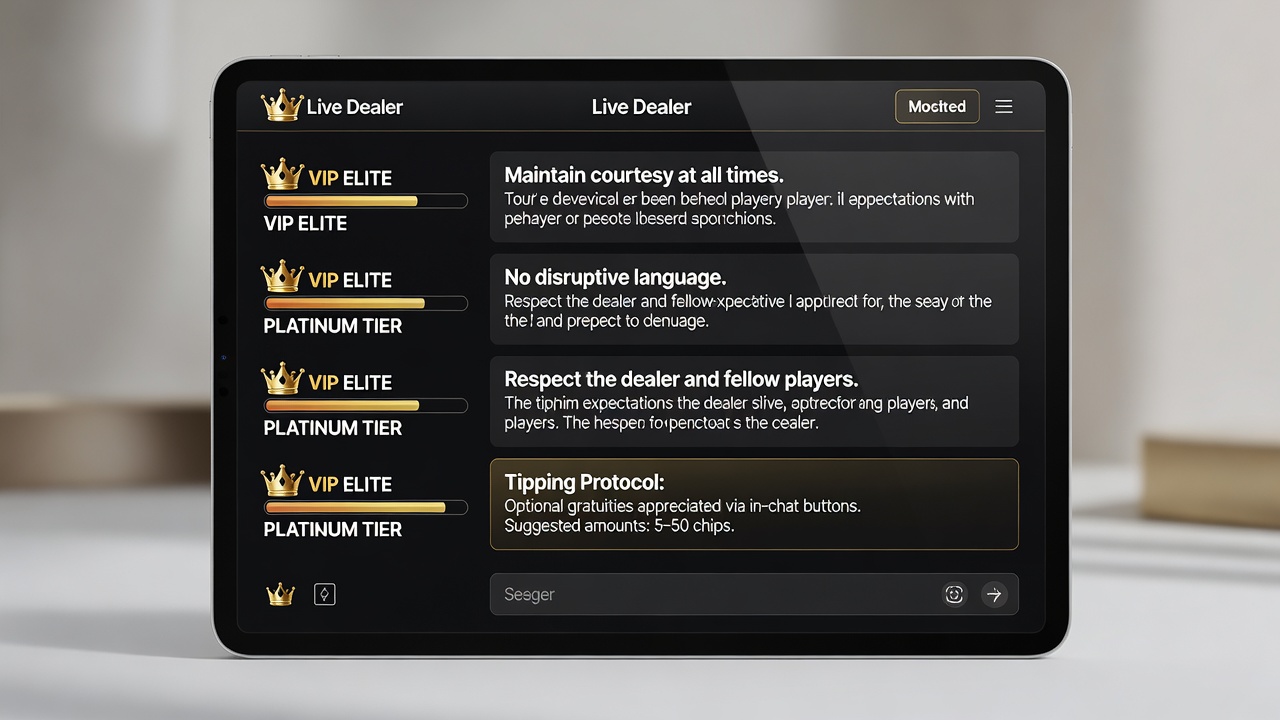
The Hierarchy
I've spent hundreds of hours in live casino rooms across Macau, Philippines, and Europe. The unwritten hierarchy is consistent across venues.
At the top: the dealer. Their word is law. They can mute you, refuse to engage, recommend a different game, or request casino floor staff to remove you. This power is absolute. They exercise it rarely, but the threat of it shapes behavior.
Second tier: the whales. These are players wagering $1,000+ per hand. They set the table's mood. If a whale wants the pace fast, the dealer accelerates. If a whale wants to socialize, the dealer engages in conversation. The whale's comfort matters.
Middle tier: regular players. Consistent bettors who show up weekly or are clearly experienced. They have informal status. Dealers remember them. Offer slightly better banter. The implicit acknowledgment that they know the rules.
Bottom tier: new players and erratic bettors. These are watched closely. If they're losing badly, they're viewed with a mixture of pity and cold professionalism. Dealers don't extend extra courtesy here.
The Chat Dynamics
Live dealer chat serves multiple functions. For the player, it's entertainment and social proof. You're not alone staring at a screen. Someone is there, talking to you, reacting to your decisions.
For the dealer, it's part of the job. They're performing hospitality. Some dealers are genuinely warm. Others are going through the motions. The warmth is correlated with tip size and player status.
The chat is monitored for compliance. Every message is logged. Dealers are instructed to report abusive language. The casino can and will ban players for racism, sexism, or extreme profanity in chat.
The Unwritten Rules
First: never insult the dealer personally. You can say the deck is hot or cold (superstition is allowed). You can complain about losing. But calling the dealer corrupt or stupid will get you muted or banned.
Second: don't make sexual remarks to the dealer. Ever. The industry is hyper-vigilant about harassment. One inappropriate comment and you're flagged.
Third: don't accuse the dealer of cheating. The casino will investigate (they take this seriously) and if they find you're being a problematic player, they'll restrict your account.
Fourth: be polite when the dealer is dealing cards to other players. Some tables are slow because other players are deciding on their hand. Don't rush. Don't publicly criticize their speed.
Fifth: if you're winning big, tip the dealer. I've watched players win $10,000 and not tip. The dealer's face doesn't change, but the message is received. The next hand, their energy shifts slightly. It's professional, but cool.
Sixth: if you're losing badly, you can disappear quietly or you can acknowledge it with humor. A player who loses $500 and then says "time to go make some real money" exits with status intact. A player who loses $500 and complains about variance for ten minutes looks like they're not in control.
The Tip Economics
Tipping in live dealer is unusual. The dealer isn't your server. But it's expected in high-stakes rooms.
The standard is somewhere between 1-5% of significant wins. $10,000 win, $100-$500 tip. Sometimes it's wagered as a bet. "I'm putting $50 on black for you." If it wins, the dealer gets it.
Not tipping when you win doesn't get you banned, but it marks you as a lower-status player. Dealers will be professional with you, but the warmth evaporates.
On losses, tipping is rare but respected. A player down $1,000 who tips the dealer is making a statement: I'm an adult with a bankroll. I can afford losses. This is just entertainment.
The Narrative Control
Experienced players understand that live dealer tables are partially a performance. The dealer is performing hospitality. The other players (if any) are performing competence.
You're performing too, whether you realize it or not. The way you bet, the way you react to results, what you say in chat. All of it constructs a narrative about who you are at the table.
If you're a whale, you can be erratic and rude. Status protects you.
If you're a regular middle-tier player, you need to be consistent and polite. Consistency signals competence. Politeness signals respect.
If you're new, you're being evaluated. You're either going to become a regular (competent, respectful) or you're going to disappear (lost money, went home).
The Unspoken Signal System
The best live dealer players are quiet. They understand the rules without needing them explained. They tip appropriately. They don't complain about the dealer's pace or other players' decisions. They don't brag about wins or whine about losses.
When a dealer interacts with a player like this, something shifts. The energy becomes collaborative instead of transactional. The dealer is rooting for them slightly. Not in a way that affects the games (the games are fair). But in a way that affects how much the dealer engages, explains things, or facilitates a pleasant experience.
This status can't be bought. It has to be demonstrated through behavior over time.
Next notes
More from #live-tables
Live Casino Hold'em Strategy: When to Call and When to Fold
Live Casino Hold'em is fundamentally different from traditional poker because you have perfect information about dealer strength. Understanding this transforms the entire decision tree.

Random Number Generation vs Live Dealers: Fairness Compared
A gentleman from Stuttgart played both live and RNG blackjack in the same evening. By three in the morning, his impressions of fairness had inverted twice.

Immersive Roulette: How Camera Angles Changed Live Play
The Resorts had a money wheel in 1978, and they filmed it with one camera from above. Evolution Films it from eight angles. The difference in the experience is architectural.
Dream Catcher: The Money Wheel That Started It All
Dream Catcher is often credited as the first live wheel game. Testing this claim methodically reveals it was actually the first one executed well enough to matter.

Which Studios Run the Best Live Dealer Tables
One might ask: what distinguishes a good casino from a bad one when the house always profits. Perhaps the answer lies in how the house profits and what it asks of the player.

How Optical Character Recognition Powers Live Dealer Games
Every card the dealer touches gets read instantly. OCR is the invisible machine that turns physical cards into game state.