Daniel Negreanu: From Toronto Pool Halls to Poker Royalty
Daniel was shooting pool in Toronto in the early 1990s. Made maybe forty grand a year. By 1997, he'd figured out poker. By 2000, he was beating the best players in the world. That's a ten-year arc from regional operator to world-class grinder.
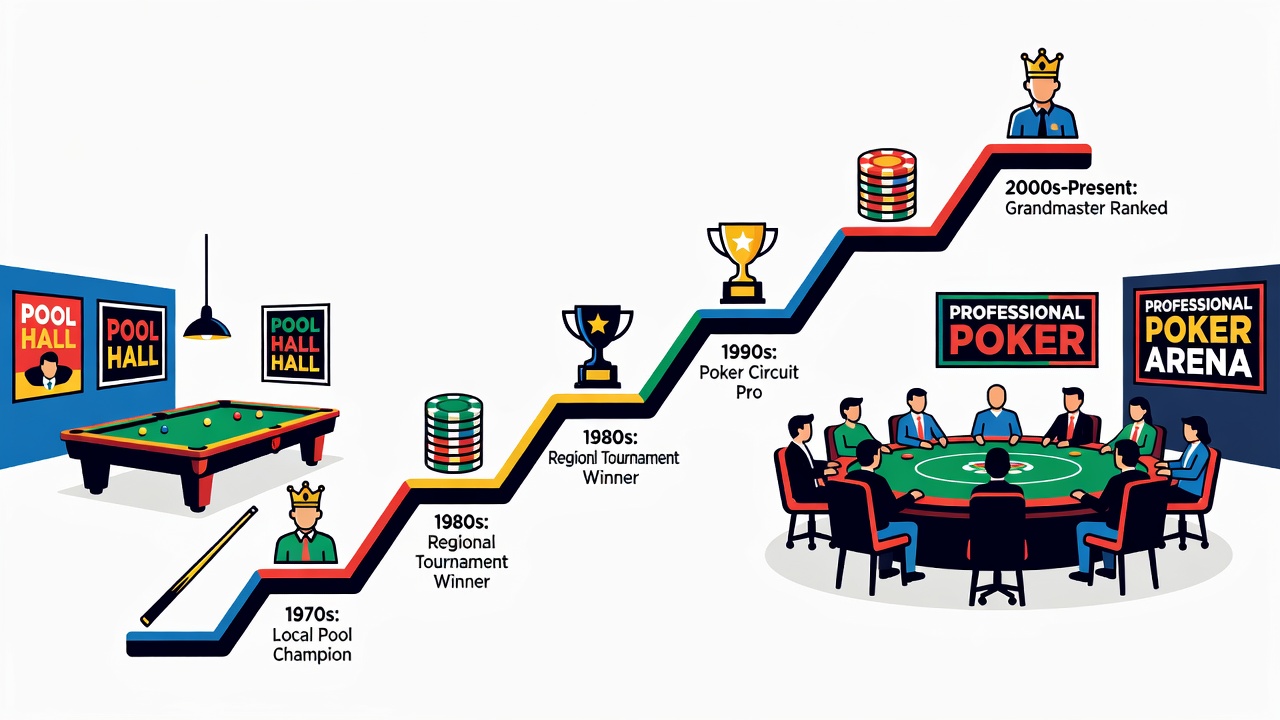
The Setup: Toronto, 1984 to 1992
Daniel John Negreanu was born April 9, 1974, in Toronto, Ontario. His father ran a plumbing business. His mother was a nurse. He played hockey as a kid, but nothing distinguished him from the general population of gifted Canadian children.
At fifteen, he started shooting pool. This is the detail that matters. Pool taught him probability, bankroll management, and psychology. A good pool player reads his opponent's confidence. He knows when to run the table and when to play scared. These skills translate to poker.
By the mid-1980s, Daniel was a world-class pool player. Not famous, but skilled enough that he was winning money consistently. He was making maybe $40,000 a year on the pool circuit. That was comfortable. He was seventeen, eighteen, nineteen years old.
The Transition: 1992 to 1995
Someone introduced him to poker. Probably through the pool circuit. Pool players and poker players occupied the same underground gambling spaces in Toronto.
Daniel started playing in small games. He was underbankrolled and inexperienced. He lost money. A lot of money. He went broke multiple times. The minimum wage was less than $5 an hour in Ontario in 1992. Going broke meant going home and working retail to rebuild.
But something clicked in him. Pool had taught him to think in probabilities and ranges. Poker formalized this thinking. By 1994, he was beating the games in Toronto. Not spectacularly, but consistently.
The Leap: 1996 to 1997
In 1996, at age twenty-two, Daniel flew to Las Vegas. He had read about the World Series of Poker. He wanted to see the big games.
He didn't have much money. He slept on a couch. He played small stakes at the Horseshoe Casino. He was terrified.
Within a few weeks, he moved to mid-stakes games. Within a few months, he was beating the biggest players in Vegas. This is not hyperbole. By late 1996, Daniel Negreanu was a skilled player, but he was not famous. By late 1997, he was approaching world-class.
What changed? Ruthlessness. He had nothing to lose. He wasn't trying to protect a reputation. He wasn't performing. He was just trying to win money from people who thought they were better than him.
The WSOP Years: 1997 to 2004
Daniel entered the 1997 World Series of Poker Main Event. He finished third for $305,000. This was a massive score for a twenty-three-year-old. It validated everything he'd learned.
He kept playing. In 1998, he won the $5,000 H.O.R.S.E. championship. In 2001, he won the $2,500 limit hold'em. In 2004, he won the World Poker Tour Championship.
Each win brought sponsorships, endorsements, appearances. He became known for his fearlessness and his willingness to play any format. If there was a game happening, Daniel would sit down.
The Peak: 2004 to 2008
By 2004, Daniel was winning major tournaments, crushing cash games, and accumulating money at a pace that would make most professionals envious.
He was also appearing on television. The WPT filmed him. Cable networks broadcast poker in prime time. Daniel's curly hair, his confident demeanor, his willingness to bluff against all odds became familiar to millions of viewers.
In 2006, he won the World Series of Poker Main Event for $8.3 million. This was the moment his name was cemented. Every poker player knew him. Casual fans knew him. He was the closest thing poker had to a movie star.
The Transition: 2008 to Present
After 2008, Daniel's tournament results declined slightly. This was partly variance, partly the emergence of a new generation of poker players trained by software and game theory instead of felt experience. By twenty-thirty-five, he was still a world-class player but no longer dominant.
He pivoted. He invested in poker education. He started a training website. He became a commentator on major tournaments. He wrote a book. The skills that made him a great player translated to teaching.
He's still alive and competing. By 2024, he's played thousands of hands, won multiple championships, made tens of millions of dollars, and helped define what modern poker looks like.
The Key Moment
The key wasn't any single tournament. It was the leap from pool hall grinder in Toronto to professional poker player in Las Vegas. That transition took guts. He had maybe $20,000 to his name. He flew to a city where he didn't know anyone, where the stakes were higher than he'd ever played, and he decided to compete against the best players in the world.
That decision, and his ability to execute on it, is what matters. The tournaments and money came after.
Next notes
More from #famous-players
Richard Marcus: The Infamous Past-Poster and Casino Cheat
Richard Marcus spent his life buying possibilities, not just in the lottery, but in the spaces between rules where people aren't looking.

Allen Iverson's Casino Bans: What the Reports Actually Say
Public records from Nevada gaming authorities show Iverson was excluded from casinos in 2012. The reasons were never fully disclosed, but the timeline reveals something about how exclusion actually works.

Kirk Kerkorian: The Quiet Billionaire Who Built Vegas Three Times
Kirk Kerkorian understood a fundamental truth about Las Vegas: the game is real estate, not gaming. Gaming is the excuse that gets people into the buildings.

Wayne Newton's Vegas Legacy and Casino Residencies
The entertainer spent more time in Las Vegas than most residents. Here's what his residency model tells us about casino hospitality architecture.

Tiger Woods and the High-Stakes Blackjack Tables of Vegas
Between 2000 and 2009, Tiger Woods was frequently photographed entering the casinos of Las Vegas. Public records show he gambled in private high-limit rooms. The amounts are documented. The outcomes are not.

Omar Sharif: Bridge Champion and Hollywood's Greatest Card Player
Omar Sharif was a world-class bridge player and a serious gambler. His career in gambling reveals something about the gap between Hollywood and the card room floor.