Omar Sharif: Bridge Champion and Hollywood's Greatest Card Player
Omar Sharif was a world-class bridge player and a serious gambler. His career in gambling reveals something about the gap between Hollywood and the card room floor.

Omar Sharif became interested in cards as a young man in Cairo. Bridge was the game that absorbed him. He approached bridge with the intensity most actors reserve for their craft. By the time he was in his thirties, working in Hollywood, he had become one of the world's strongest bridge players.
Sharif's approach to bridge was mathematical. He understood probability, he understood opponent modeling, and he understood the importance of discipline. These are not theatrical skills. They are the cold, technical skills required to win at the highest levels of competitive bridge.
What made Sharif unusual was that he treated bridge as seriously as he treated film. He would turn down dinner invitations to prepare for tournaments. He would skip social events to study new bidding systems. For most actors in his era, gambling was a social activity or a vice. For Sharif, it was work.
The Bridge Years
Sharif won the Lancia d'Oro tournament in Italy, one of the world's strongest bridge competitions. He played regularly at high-stakes tables in Monte Carlo and London. He published articles on bridge strategy. He was not a celebrity playing cards; he was a serious player who happened to be a celebrity.
What bridge represents architecturally is the inverse of casino games. Bridge has imperfect information. You do not know what your partner holds. You do not know what your opponents hold. You must bid based on probability and convention. The player who can accurately estimate unseen hands wins.
Sharif's success at bridge came from understanding what was hidden. He could infer from betting patterns what cards his opponents held. He could bid accurately despite having incomplete information. This is the skill casino games explicitly try to prevent.
Gambling vs Playing
There is a distinction between gambling and card playing, and Sharif understood it. Gambling on pure chance games, like roulette or slots, is entertainment with a known cost. Card playing, whether bridge or poker, is a skill pursuit.
Sharif gambled socially, but his serious money went to games where skill mattered. He understood that poker and bridge had edges that roulette did not. He pursued them accordingly.
Hollywood contemporaries who gambled, like Dean Martin and Frank Sinatra, gambled for the experience and the mythology. Sharif gambled as a professional gambler who happened to act. The difference is not small.
The Las Vegas Period
Sharif spent time in Las Vegas during the 1970s and 1980s. He played bridge in high-stakes rooms. He played poker. He mixed with the card room professionals who populated the circuit at that time. He was not a whale being fleeced. He was a competitor.
By most accounts, he held his own. Some years he won. Some years he lost. The variance of card games is high, even for skilled players. But over a long period, his mathematical understanding gave him an edge.
What prevented Sharif from becoming a full-time professional gambler was not his lack of skill. It was that his acting career was more lucrative and more prestigious. He had the luxury of treating bridge and poker as serious pursuits without needing them to be his livelihood.
The Legacy
Sharif's importance is not that he was a great gambler. It is that he demonstrated what serious gambling looks like. He studied. He practiced. He treated the game as a discipline, not a pastime.
This is absent from the modern casino experience. The modern casino is designed for entertainment, not for competition. The slots do not reward skill. The live dealer games are structured to prevent advantage play. The RNG games are licensed to produce a specific house edge.
In Sharif's era, skill mattered more. A serious player could build an edge. The casino was a place where mathematical intelligence could compete. This made the gambler a different animal than the entertainment gambler.
Sharif died in 2003. The world of competitive gambling has changed substantially since his playing days. But he remains an example of something that is harder to find now: the intellectual gambler who treats the game as a discipline rather than a thrill.
Next notes
More from #famous-players
Richard Marcus: The Infamous Past-Poster and Casino Cheat
Richard Marcus spent his life buying possibilities, not just in the lottery, but in the spaces between rules where people aren't looking.

Allen Iverson's Casino Bans: What the Reports Actually Say
Public records from Nevada gaming authorities show Iverson was excluded from casinos in 2012. The reasons were never fully disclosed, but the timeline reveals something about how exclusion actually works.

Kirk Kerkorian: The Quiet Billionaire Who Built Vegas Three Times
Kirk Kerkorian understood a fundamental truth about Las Vegas: the game is real estate, not gaming. Gaming is the excuse that gets people into the buildings.

Wayne Newton's Vegas Legacy and Casino Residencies
The entertainer spent more time in Las Vegas than most residents. Here's what his residency model tells us about casino hospitality architecture.
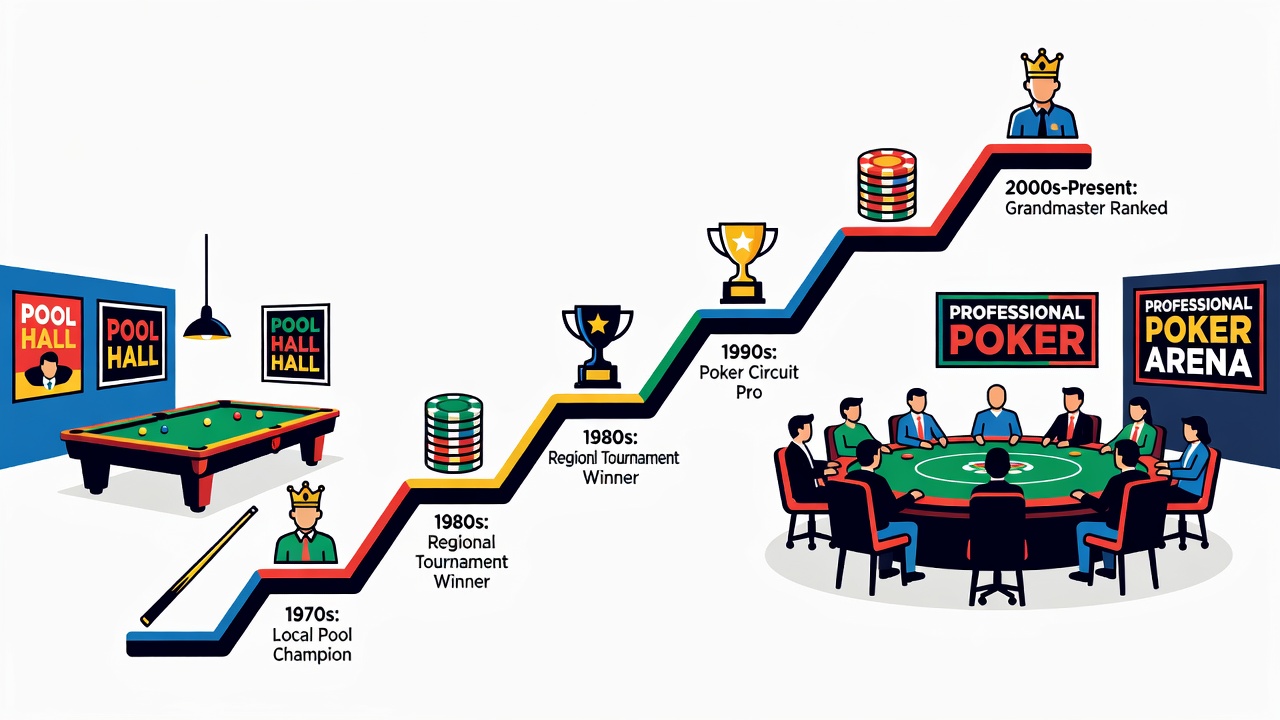
Daniel Negreanu: From Toronto Pool Halls to Poker Royalty
Daniel was shooting pool in Toronto in the early 1990s. Made maybe forty grand a year. By 1997, he'd figured out poker. By 2000, he was beating the best players in the world. That's a ten-year arc from regional operator to world-class grinder.

Tiger Woods and the High-Stakes Blackjack Tables of Vegas
Between 2000 and 2009, Tiger Woods was frequently photographed entering the casinos of Las Vegas. Public records show he gambled in private high-limit rooms. The amounts are documented. The outcomes are not.