Live Dragon Tiger: The Simplest Table Game You'll Ever Learn
Dragon Tiger appears deceptively simple: two cards, pick which is higher. The design hides specific psychological reinforcement mechanisms that increase engagement.
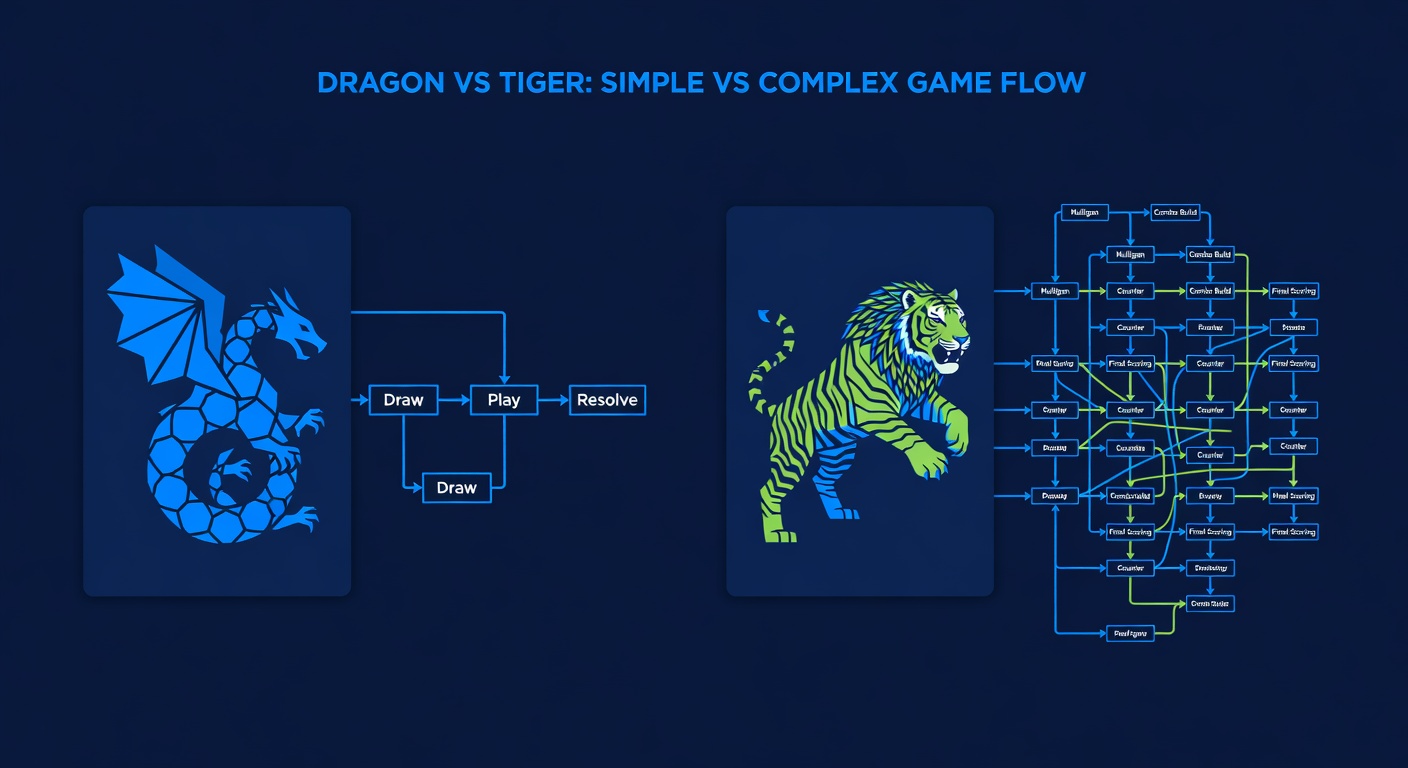
Dragon Tiger is baccarat's younger sibling, stripped of complexity for maximum accessibility. That simplicity is the design.
The Mechanics
Two cards deal: one to the Dragon position, one to the Tiger position. Higher card wins. Ties push your bet. That's it. No hand rankings to memorize. No soft hands or hard hands. A seven beats a six.
The game was introduced in Cambodia in the early 2000s and now dominates live dealer lobbies. Evolution Gaming, Pragmatic Play, and Playtech all offer live Dragon Tiger. Why the prevalence? Because it lowers the decision burden for new players while maximizing betting frequency.
A hand resolves in under 30 seconds. No strategic choice. No turn or river. Outcome is instant and binary.
The Reinforcement Schedule
From a behavioral psychology perspective, Dragon Tiger employs variable-ratio reinforcement at its core. You make a choice (Dragon or Tiger), you receive immediate feedback (win, lose, push), and the game resets.
This rapid cycle is intentional. A typical baccarat hand lasts 2-4 minutes. A Dragon Tiger hand lasts 30 seconds. Over an hour, you experience 3-4 times more decision points. Each decision point carries a small emotional valence: anticipation before reveal, resolution after reveal.
The near-miss effect operates here as well. You pick Dragon. Tiger comes back 6-5. The cards were close. Psychological research (Cote et al., 2003) shows that near-misses prompt continued play more than decisive losses. Dragon Tiger creates near-misses frequently.
Why Simplicity Increases Play
Cognitive load is minimal. A new gambler needs 30 seconds to understand Dragon Tiger. Baccarat requires 5-10 minutes of explanation (banker hand vs. player hand, 8s and 9s, commission structures). Craps demands 15 minutes.
This accessibility has economic effects. Operators report that Dragon Tiger tables convert 60-80% of observers into players. Craps tables convert 20-30%. The simplicity removes friction.
The speed also prevents reflection. Between hands at a slower game, a player can think about their strategy or their losses. Between Dragon Tiger hands, they cannot. The next round begins before the previous one metabolizes.
The Live Dealer Element
There's a human dealing the cards. This matters more than the game mechanics suggest. Research on live gaming (Gainsbury et al., 2015) shows that live dealers increase play duration relative to automated games. The presence of another person creates social presence, even across video.
The dealer's chat, their personality, their commentary on near-misses ("Oh, so close!") all contribute to engagement. A player losing at a RNG-powered slot experiences loss in isolation. A player losing at live Dragon Tiger hears the dealer sympathize.
Psychologically, this transforms a mathematical loss into a social event.
The Chasing Effect
Dragon Tiger's speed enables a specific harm pattern: escalated betting following losses. The player loses $100 on Dragon. The next hand is 20 seconds away. They increase to $150. The speed of resolution reduces the temporal distance between loss and the opportunity to recover.
Slower games interrupt this cycle. A blackjack hand resolves in 30-45 seconds, but the shoe proceeds through 60+ hands per hour. There's interval, not continuity. Dragon Tiger feels like a single continuous decision tree, despite being discrete hands.
The Design Lesson
Dragon Tiger is elegant game design for engagement. Reduced complexity plus rapid resolution plus live presence equals sustained play. It is not cynical to observe this. It is honest.
Regulatory frameworks acknowledge this. The UKGC and MGA monitor Dragon Tiger play patterns specifically because its design characteristics align with increased problem-gambling indicators in the literature.
Understanding why Dragon Tiger works is the first step toward understanding one's own response to it.
Next notes
More from #live-tables
Live Casino Hold'em Strategy: When to Call and When to Fold
Live Casino Hold'em is fundamentally different from traditional poker because you have perfect information about dealer strength. Understanding this transforms the entire decision tree.

Random Number Generation vs Live Dealers: Fairness Compared
A gentleman from Stuttgart played both live and RNG blackjack in the same evening. By three in the morning, his impressions of fairness had inverted twice.
Immersive Roulette: How Camera Angles Changed Live Play
The Resorts had a money wheel in 1978, and they filmed it with one camera from above. Evolution Films it from eight angles. The difference in the experience is architectural.
Dream Catcher: The Money Wheel That Started It All
Dream Catcher is often credited as the first live wheel game. Testing this claim methodically reveals it was actually the first one executed well enough to matter.

Which Studios Run the Best Live Dealer Tables
One might ask: what distinguishes a good casino from a bad one when the house always profits. Perhaps the answer lies in how the house profits and what it asks of the player.

How Optical Character Recognition Powers Live Dealer Games
Every card the dealer touches gets read instantly. OCR is the invisible machine that turns physical cards into game state.