Why Live Dealer Games Feel More Trustworthy to Many Players
Players trust what they can see. Live dealer casinos exploit this cognitive bias. The visible dealer, the visible cards, the visible wheel are all theater that produces a feeling of control. What it conceals is another matter.
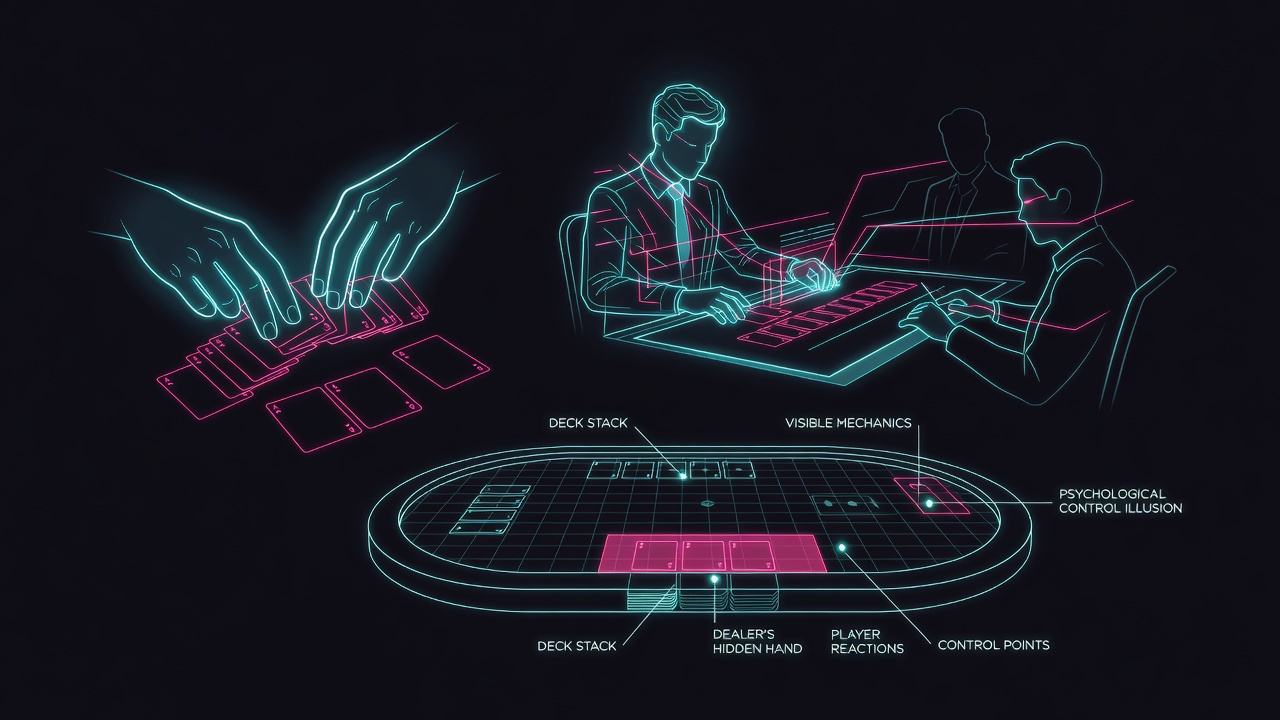
The case for live dealer games rests on a simple principle: you can see the dealer. You can watch their hands. You can observe the shuffle. You can see the cards emerge from the shoe. For a player who has spent hours worrying that an online random-number generator is rigged against them, this visibility is psychologically powerful.
The problem with this reasoning is that it conflates visibility with fairness. A dealer you can see is not inherently fairer than an RNG you cannot. The RNG at Evolution Gaming, Pragmatic Play, or DraftKings is tested by third-party auditors. The shuffle at a live table is performed by a human. Humans are worse at randomization than computers.
The Cognitive Architecture of Trust
Research in behavioral economics shows that people assign higher probability to events they can observe than to events they cannot. This is true even when the observed event is actually less likely. A player watching a live roulette wheel spin feels more certain about the fairness of the outcome than a player seeing a digital result appear on screen. This feeling is not based on evidence. It is based on the ability to narrate a story about what happened.
When you watch a dealer shuffle, you are constructing a narrative: this person is performing an action, the action creates randomness, the randomness produces the outcome. This narrative feels like proof of fairness. The RNG is a black box. No narrative emerges from it.
The MGA (Malta Gaming Authority) and UKGC (UK Gambling Commission) both require that live dealer games produce results equivalent to tested RNGs. Evolution Gaming publishes reports on the fairness of their shuffles. The mathematics of their shuffle have been audited. The results match the stated house edge to within confidence intervals.
None of this changes the player's feeling. The feeling persists because it rests on something true: they saw it happen.
The Cost of Visibility
Live dealer games carry much higher overhead than RNG-based games. A dealer costs money. A studio costs money. A broadcast infrastructure costs money. A player who chooses live dealers over RNG games is paying for visibility. The house edge does not change. The cost of the experience is baked into the margins.
At European online casinos, live blackjack frequently runs at higher stakes than RNG-based blackjack. The house edge is identical. The game rules are identical. The only difference is that you are paying a premium for the privilege of watching someone shuffle.
A crypto casino operator explained this to me once with disarming honesty: players prefer live dealers because they feel they have an edge when they can see the dealer. The perception of control is worth enough premium to offset the operational costs. The operator does not have to debate fairness. They simply provide the experience and let the narrative do the work.
What Visibility Actually Tells You
A live dealer cannot cheat you in ways an RNG can, because a human dealer is constrained by the physical laws of cards and balls. A human dealer also cannot generate a house edge larger than 2-3 percent through standard dealing. The casino makes money on the rake and the mathematics of the game, not through dealing manipulation.
But a live dealer also cannot guarantee fairness better than an RNG. The shuffle of a deck by hand is less random than the shuffle produced by a pseudo-random algorithm. The ball in a physical roulette wheel is subject to physics that could, in principle, be predicted. Neither of these facts produces bias against the player. They are just facts about the nature of the systems.
The player watching the live dealer win is witnessing randomness. The player watching the RNG produce the same distribution is also witnessing randomness. The difference is entirely in what they can narrate.
Visibility is not evidence of fairness. It is evidence of visibility. A player who understands this difference can make a clearer decision about whether they prefer to pay the premium for live dealers or pocket the savings and play RNG-based games. The fairness is not in question either way. The only question is what they prefer to watch while they lose money.
Next notes
More from #live-tables
Live Casino Hold'em Strategy: When to Call and When to Fold
Live Casino Hold'em is fundamentally different from traditional poker because you have perfect information about dealer strength. Understanding this transforms the entire decision tree.

Random Number Generation vs Live Dealers: Fairness Compared
A gentleman from Stuttgart played both live and RNG blackjack in the same evening. By three in the morning, his impressions of fairness had inverted twice.
Immersive Roulette: How Camera Angles Changed Live Play
The Resorts had a money wheel in 1978, and they filmed it with one camera from above. Evolution Films it from eight angles. The difference in the experience is architectural.
Dream Catcher: The Money Wheel That Started It All
Dream Catcher is often credited as the first live wheel game. Testing this claim methodically reveals it was actually the first one executed well enough to matter.
Which Studios Run the Best Live Dealer Tables
One might ask: what distinguishes a good casino from a bad one when the house always profits. Perhaps the answer lies in how the house profits and what it asks of the player.

How Optical Character Recognition Powers Live Dealer Games
Every card the dealer touches gets read instantly. OCR is the invisible machine that turns physical cards into game state.